
A new GameDiscoverCo report examines how Steam wishlist numbers translate into actual sales during a game’s first week on the platform. By analyzing titles released between September 2024 and September 2025, the report outlines trends around conversion rates, pricing, and player sentiment. Unlike earlier studies that focused only on players who had wishlisted a title, this report includes all first-week purchases, offering a broader look at how well wishlists predict sales performance.
What the Data Says About Wishlist Conversion
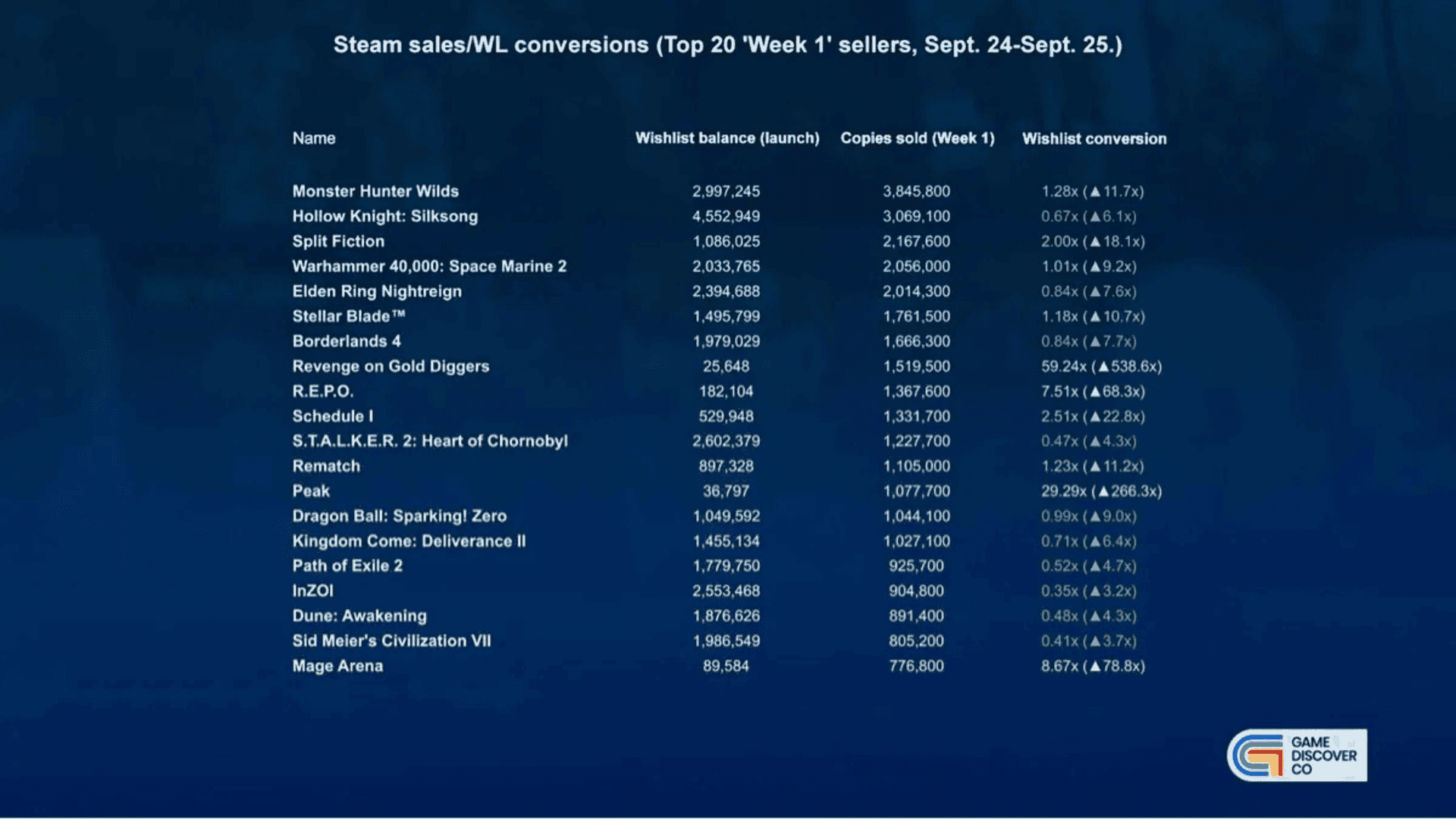
GameDiscoverCo identifies a median conversion rate of 0.15× for games that launched with more than 25,000 wishlists. This means that for every 100,000 wishlists a game collects before launch, developers can expect roughly 15,000 sales in the first week. The report stresses that these figures fluctuate significantly from project to project. According to the findings, conversion rates can differ by an order of magnitude depending on genre, market timing, and audience behavior.
Pricing also plays a role. Games launching above the $10 price point tend to convert at a lower median rate of 0.10×. The report notes that NSFW titles outperform the broader market, and when they are excluded, the median conversion rate drops slightly to 0.14×.
Despite concerns that Steam is becoming oversaturated, GameDiscoverCo states there is no evidence of a long-term decline in conversion performance. Instead, the challenge lies in collecting wishlists at all, as more games compete for visibility and user attention.
Standout Titles Reveal How High Conversion Can Go
While the median conversion rate helps set realistic expectations, some games perform far above the average. The report highlights titles like Peak, Mage Arena, and R.E.P.O., which drove exceptional conversion rates during their launch windows. Peak reached a conversion rate of 29.29×, far exceeding standard performance. Mage Arena landed at 8.67×, and R.E.P.O. at 7.51×. These examples show that strong community interest or viral attention can drive sales without relying heavily on wishlisting behavior.
The data also shows that not all games use wishlisting in the same way. AAA releases may see fewer wishlists because players often choose to preorder instead. On the other hand, some indie games gain momentum rapidly through social chatter or streaming and never accumulate a large wishlist backlog because potential buyers choose to purchase immediately.
Player Reception and Pre-Launch Cycles Influence Sales
GameDiscoverCo also compares high-performing titles with those that underperformed against expectations. According to the report, underperforming releases typically launched to a first-week user score of around 67 percent on Steam, compared to 91 percent for games that surpassed conversion expectations. Early reception appears to influence sales during the critical opening week, suggesting that visibility alone cannot carry a weak launch.
The preorder and wishlist period also matters. Underperforming titles averaged 411 days in pre-release visibility on Steam, while better-performing games averaged 214 days. The report suggests that long pre-release cycles may cause momentum to fade before launch, diluting the demand that initially drives wishlisting behavior.
Source: GameDiscoverCo
Frequently Asked Questions (FAQs)
How many sales can 100,000 Steam wishlists generate?
Based on the latest GameDiscoverCo report, a typical conversion rate is around 0.15×, meaning 100,000 wishlists may lead to roughly 15,000 first-week sales.
Do higher game prices reduce conversion rates?
Yes. Games priced above $10 at launch show a lower median conversion rate of 0.10×.
Are wishlist conversions declining over time?
GameDiscoverCo reports no long-term decline in conversion effectiveness. Instead, competition on Steam is making it harder for games to collect wishlists in the first place.
What impacts conversion the most - wishlist count or user reviews?
Both matter, but early user reception strongly correlates with performance. Games that exceeded expectations had significantly higher user ratings in the first week.
Do long pre-release periods help?
Not necessarily. Titles that stayed in pre-release visibility for extended periods generally converted worse due to fading momentum.
Does this data apply to indie and AAA games?
Yes. The dataset includes both. AAA titles may rely less on wishlists due to preorder behavior, while indie games often rely more heavily on wishlist-driven awareness.