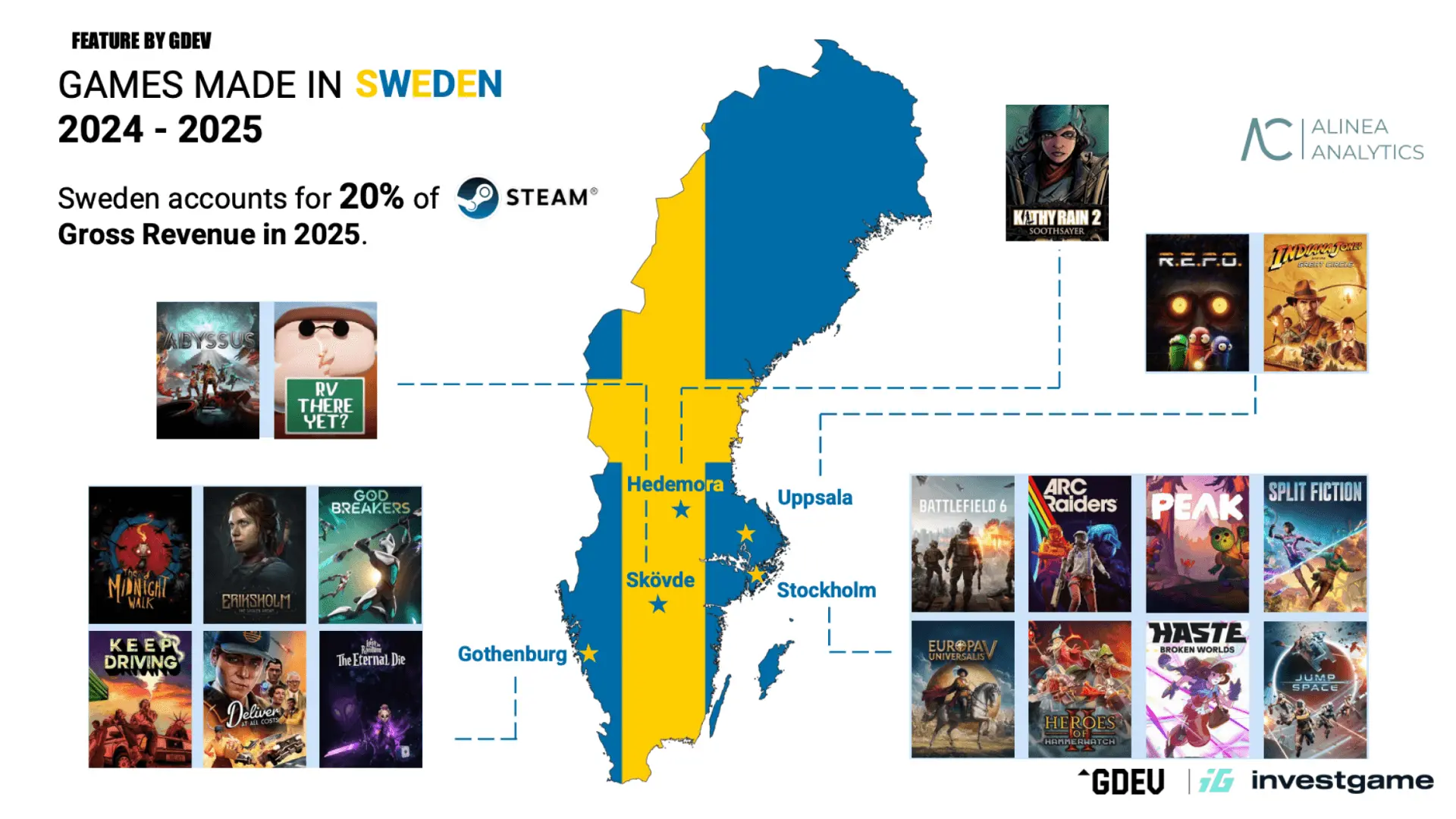

Sweden has emerged as a key player in the global gaming industry, producing an outsized number of hits relative to its population. In 2025, Swedish developers generated roughly 20% of Steam’s gross revenue, according to InvestGame x GDEV x Alinea Analytics. During the 2024–2025 release window, five Swedish-made games ranked among Steam’s global top-10 bestsellers: Battlefield 6, R.E.P.O., Peak, ARC Raiders, and Split Fiction.
Unlike larger markets that focus on volume through numerous studios and investments, Sweden has focused on efficiency, producing high returns per studio and ranking as the world’s second-largest producer of unicorns per capita. This level of performance is often described as “hit density,” reflecting the number of global breakout titles relative to the size of the ecosystem. Sweden has never dominated venture capital headlines like the United States or the United Kingdom, yet its creative output per dollar invested remains among the highest in the world.
More than 1,100 game companies operate in Stockholm, Malmö, and Gothenburg, producing AAA franchises like Battlefield and Paradox Interactive titles, survival hits such as Valheim and V Rising, viral indie successes like R.E.P.O. and RV There Yet?, and Sony’s fastest-selling first-party release, Helldivers II.
A Balanced Approach Across Platforms
Swedish developers have maintained strength across both PC and console as well as mobile gaming. Studios such as Arrowhead, Embark Studios, Paradox Interactive (STO: PDX), MachineGames, and Coffee Stain Group (STO: COFFEE B) have built globally recognized franchises through consistent design quality and technical depth.
In mobile, King’s $5.9 billion sale to Activision Blizzard demonstrated that Swedish operators could scale at a global level. Following this milestone, public companies like Stillfront (STO: SF), MTG (STO: MTG), and Embracer (STO: EMBRAC B) expanded aggressively through mergers and acquisitions, creating some of Europe’s largest mobile gaming portfolios.
The Swedish gaming model has relied on public market funding to support rapid expansion, particularly during periods of low interest rates. Companies were able to fund acquisitions and consolidate IP across multiple regions, creating large portfolios and strengthening their positions in global gaming markets.
From Expansion to Market Reset
Between 2014 and 2025, Sweden’s gaming ecosystem recorded $19.2 billion in transactions across 362 deals, including $811 million in private investments, $8.3 billion in public offerings, and $10.1 billion in mergers and acquisitions. Public market activity drove rapid consolidation, but the rise in interest rates and changing economic conditions led to a slowdown in growth and a reset in valuations. Several leading public acquirers entered periods of strategic review and restructuring, marking a clear contrast to the aggressive M&A approach seen just a few years prior.
Despite the market reset, Swedish studios continued to produce globally successful titles. This suggests that long-term gaming value is closely tied to studio output, creative talent, and IP development rather than financial leverage. The creative engine has remained resilient, producing hits across PC, console, and mobile even as access to capital tightened.
What Sweden’s Gaming Model Teaches About Value Creation
Sweden’s experience demonstrates that sustainable gaming success is rooted in consistent production quality and technical expertise. While financial strategies and market consolidation can amplify growth, the continued success of Swedish studios shows that value is ultimately created at the studio level. This approach offers lessons for global markets, including the growing web3 gaming sector, where long-term returns are likely to come from product execution rather than speculative investment.
The country’s focus on efficiency, talent density, and hit-making ability positions it well for future growth, even as the pace of acquisitions slows. Swedish developers continue to set a standard for how a relatively small ecosystem can compete on the global stage by combining creative excellence with disciplined expansion.
Source: InvestGame x GDEV x Alinea Analytics
Frequently Asked Questions (FAQs)
Why is Sweden so successful in gaming?
Sweden’s gaming success comes from a high concentration of skilled developers, strong studio culture, and a focus on producing high-quality games that perform well globally. Its relatively small market size encourages efficiency and innovation, leading to a high “hit density” of breakout titles.
Which Swedish studios are most influential?
Key studios include Paradox Interactive, Coffee Stain Group, Arrowhead, Embark Studios, and MachineGames. These companies have produced globally recognized AAA titles, survival games, and viral indie successes.
How has Sweden’s gaming capital model changed?
Between 2014 and 2025, Swedish gaming companies expanded through public market funding and M&A, totaling $19.2 billion in transactions. Rising interest rates and valuation adjustments led to a reset, slowing acquisitions but leaving studios operational and creative output intact.
Does Sweden dominate mobile gaming?
Yes. King’s $5.9 billion sale to Activision Blizzard highlighted Sweden’s ability to operate at a global scale. Public companies like Stillfront, MTG, and Embracer have built large mobile gaming portfolios through M&A and strategic acquisitions.
What can other markets learn from Sweden?
Sweden shows that long-term gaming value comes from studio-level execution, technical expertise, and IP development. Financial strategies can accelerate growth, but consistent creative output is the primary driver of sustained success.
Is Sweden involved in web3 gaming?
While not a leading web3 hub, Sweden’s focus on high-quality game production and innovative development practices positions its studios to explore web3 opportunities as the market evolves.