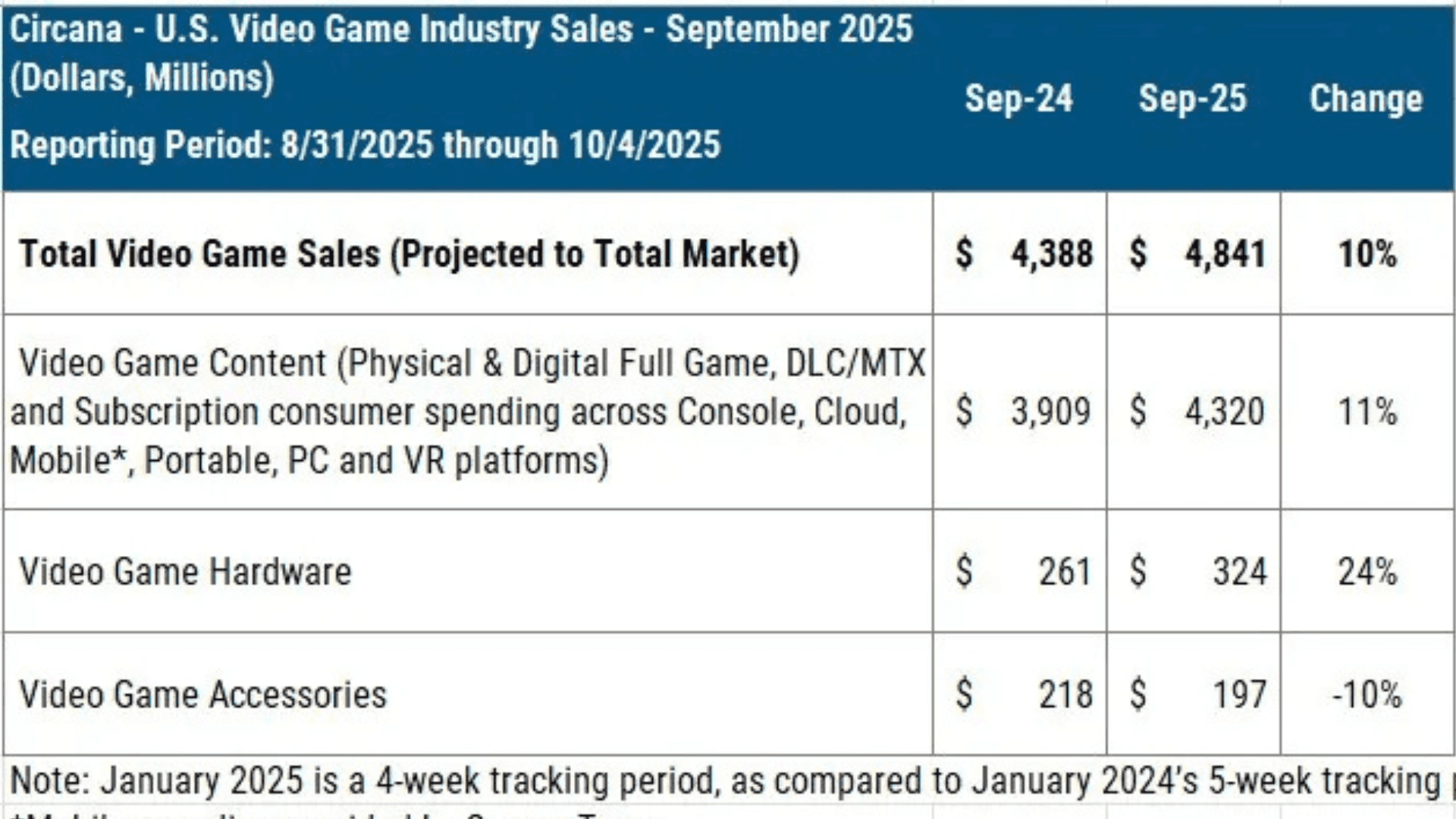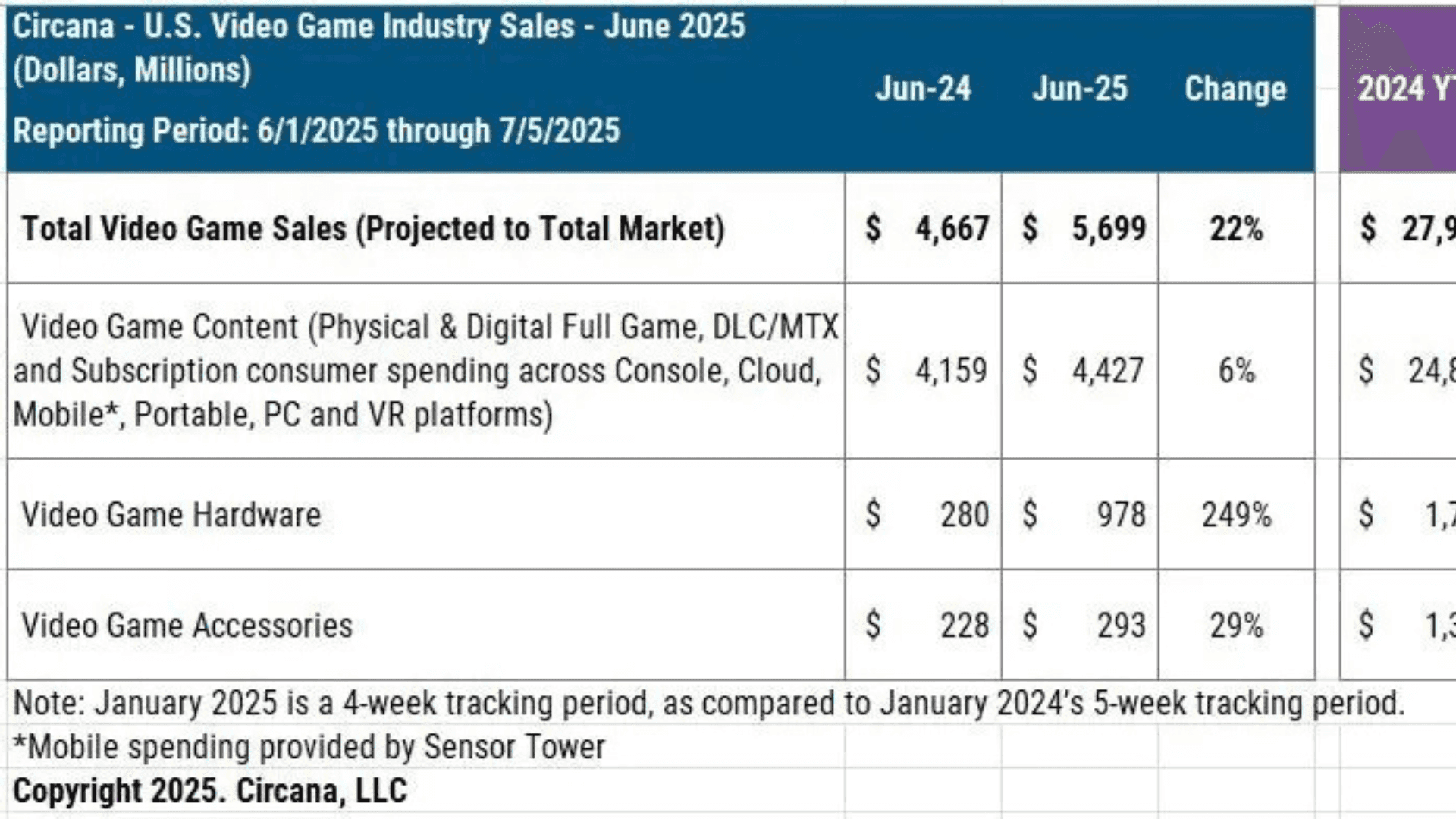

The US gaming market experienced a mixed performance in November 2025, according to Circana. Total revenue for the month reached $5.861 billion, representing a 4% decline compared to the same period last year. While overall spending fell, content sales showed modest growth, rising 1% to $4.84 billion. Subscription services continued to see strong demand, with user spending increasing by 16%, and the mobile segment grew by 2%. Meanwhile, PC and console content sales saw declines, reflecting ongoing challenges for traditional game sales in the current market.
Physical game sales fell by 14% year over year, reaching their lowest November levels since 1995. Despite these declines, cumulative revenue for the first 11 months of 2025 remains slightly ahead of 2024, indicating the market has largely held steady across the year.
Hardware Sales Decline While Prices Rise
Hardware sales faced a notable drop in November, falling 27% year over year to $695 million. This represents the lowest November revenue for consoles since 2005. Around 1.6 million devices were sold, close to the historic low of 1.4 million units in November 1995 and well below the 3.9 million units sold in November 2019.
Average device prices have risen sharply in recent years. In November, the average price reached $439, up 11% from the previous year and nearly double the $235 recorded in November 2019. Among platforms, PlayStation 5 was the best-selling console, followed by Nintendo Switch 2. The NEX Playground, a gesture-controlled console designed for children, surpassed Xbox Series S|X in unit sales, highlighting continued interest in alternative gaming devices inspired by ideas like EyeToy and Kinect.
Accessory Market Trends
Accessory sales declined by 13% in November, totaling $327 million, with gamepad sales down 19% year over year. The PlayStation Portal led accessory revenue, while the DualSense controller was the top-seller in units. These trends reflect ongoing shifts in spending priorities among gamers, with higher-priced devices and subscription services capturing more of the market share.
Top-Selling Games
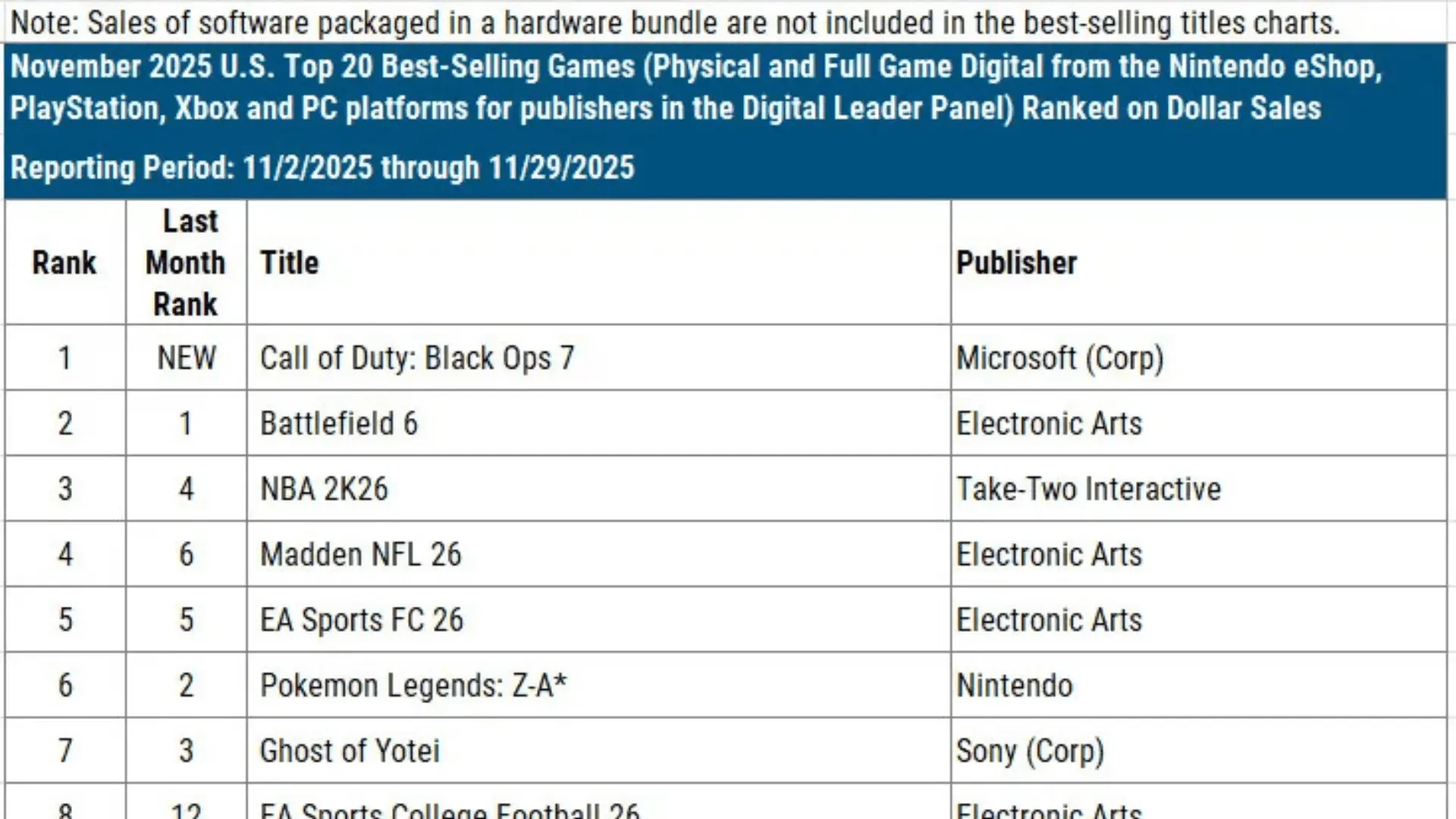
Call of Duty: Black Ops 7 was the best-selling game of November, though its launch performance was weaker than previous entries in the series. Despite lower sales, the franchise secured its 18th consecutive launch-month lead. Other new releases included Kirby Air Riders and Hyrule Warriors: Age of Imprisonment, which ranked 10th and 11th, though digital sales data was unavailable for both, suggesting their actual rankings could be higher.
For the year so far, Battlefield 6, NBA 2K25, and Monster Hunter: Wilds have led overall sales. Call of Duty: Black Ops 7 launched in seventh place for the year, marking a comparatively weaker entry for the franchise. In the mobile and free-to-play segment, MONOPOLY GO!, Royal Match, Last War: Survival, Candy Crush Saga, and Clash Royale were the highest-grossing games for the month.
Platform Performance and Player Activity
On both PlayStation and Xbox, Call of Duty: Black Ops 7 led sales, with rankings largely consistent between platforms aside from PlayStation exclusives. Fortnite maintained the highest monthly active user count on both consoles. On Nintendo platforms, Pokémon Legends: Z-A retained first place in sales, with new releases entering the top three positions. Nintendo continued to dominate its own ecosystem, publishing eight of the top ten titles on the platform.
PC sales also saw Call of Duty: Black Ops 7 at the top, with Football Manager 2026 performing strongly in the US market. On Steam, ARC Raiders led in monthly active users for November, indicating that online engagement remains a key metric alongside traditional sales figures.
Publisher Strategies and Web Shop Growth
Publishers are increasingly turning to direct-to-consumer platforms and web shops to capture higher-value spending. Tilting Point’s collaboration with Xsolla in titles like Warhammer: Chaos & Conquest and Star Trek: Timelines shows a trend toward off-store payments, allowing publishers to maximize revenue from high-value users. In these cases, more than half of repeat purchases and overall revenue are generated through web shops, highlighting the growing importance of web3-adjacent commerce strategies in the gaming industry.
Final Thoughts
The US gaming market in November 2025 shows a complex picture. While hardware sales declined and average prices rose, subscription growth and strong mobile performance provided counterbalance. Major franchises like Call of Duty continue to lead, even if individual game launches are weaker than in the past. The market remains stable overall, but shifts in spending habits, platform preferences, and monetization strategies indicate ongoing evolution within the industry.
Source: Circana
Frequently Asked Questions (FAQs)
What was the total revenue for the US gaming market in November 2025?
Total revenue reached $5.861 billion, down 4% compared to November 2024.
Which console was the best-selling in November 2025?
The PlayStation 5 was the best-selling platform, followed by Nintendo Switch 2 and The NEX Playground.
How did Call of Duty: Black Ops 7 perform?
It was the best-selling game of November in revenue but had weaker sales compared to previous entries in the series.
What were the trends in hardware pricing?
Average hardware prices increased 11% year over year, reaching $439, nearly double the average in November 2019.
Which games led mobile and free-to-play revenue in November 2025?
MONOPOLY GO!, Royal Match, Last War: Survival, Candy Crush Saga, and Clash Royale were the top-grossing mobile titles.
How are publishers using web shops and web3-related strategies?
Publishers like Tilting Point are directing high-value users to web shops for off-store payments, increasing revenue margins and repeat purchases in titles such as Warhammer: Chaos & Conquest and Star Trek: Timelines.
Which games led PC and Steam activity?
Call of Duty: Black Ops 7 was the top-selling PC game, while ARC Raiders led in monthly active users on US Steam.