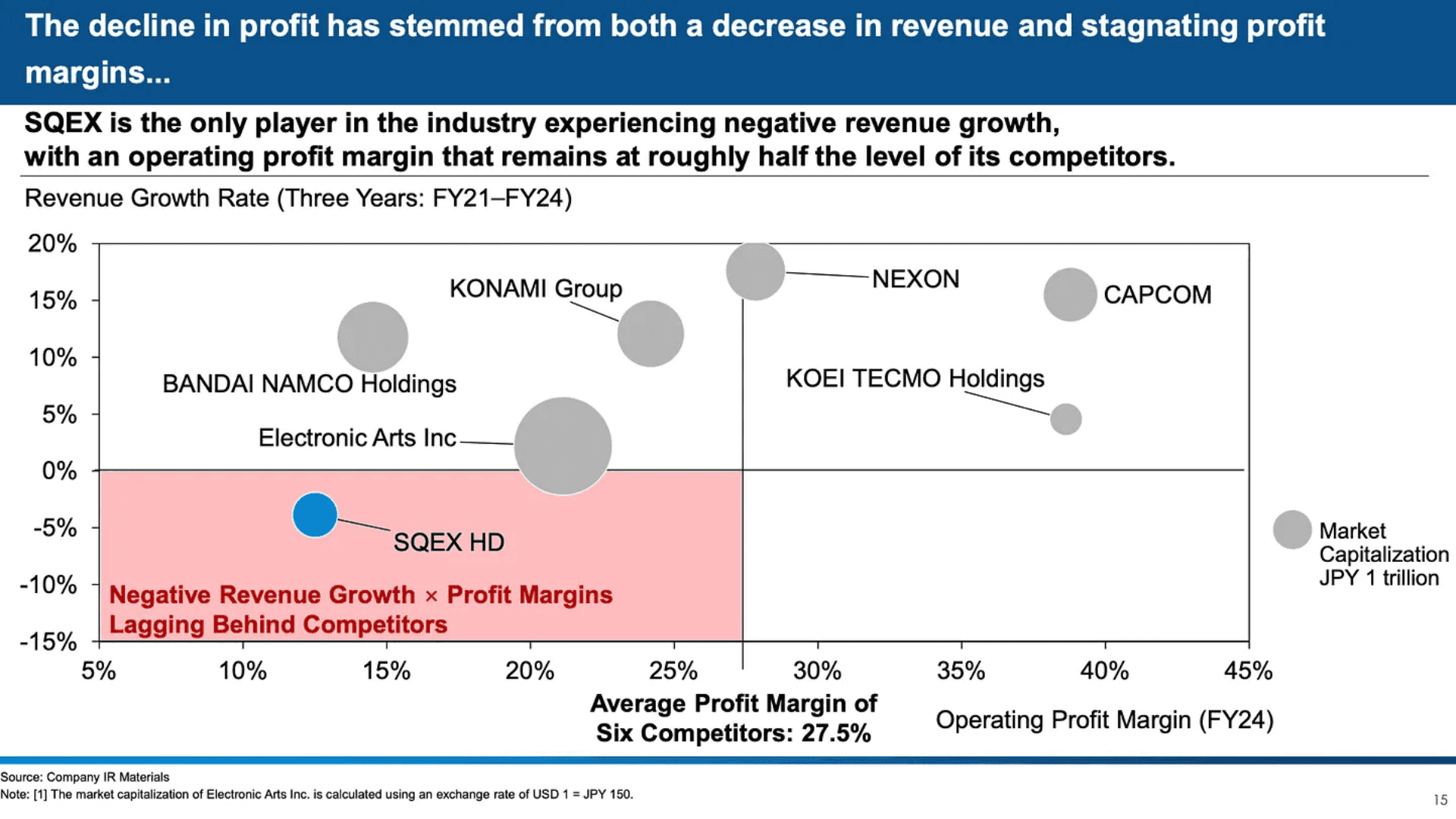

Square Enix is under fresh scrutiny following the public release of a critical report from major shareholder 3D Investment Partners. The report, which was originally presented to the company in September, outlines concerns about revenue performance, declining profitability, and the direction of its three-year strategic plan. The investor group’s decision to publish the document months later indicates that its criticisms remain unresolved, even after Square Enix issued a major corporate update in November.
Investor Criticism Reignites Debate Over Square Enix’s Strategy
The report from 3D Investment Partners includes a detailed breakdown of Square Enix’s financial standing compared with several major global publishers. Its charts highlight stagnating revenue growth and weaker operating profit margins, suggesting that the company is falling behind some of its most direct competitors. The presentation also questions internal decision-making structures and raises concerns about the long-term value of maintaining non-core divisions, including arcade maker Taito.
These criticisms were originally shared privately with Square Enix leadership, but according to 3D Investment Partners, the company did not provide the clarity or structural commitments requested. The group says it asked president Takashi Kiryu for a new framework to reassess management priorities but received only a brief response indicating such a review was unnecessary. This exchange ultimately triggered the public release of the September slide deck and an accompanying statement urging other shareholders to evaluate the information.
AI, Restructuring, and Layoffs Add Context to the Conflict
The dispute comes shortly after Square Enix published its updated three-year plan in November. That update drew attention because it outlined significant operational changes, including a goal to have AI handle around 70 percent of quality assurance tasks. The update also confirmed that development resources would continue to shift toward Japan amid ongoing consolidation, accompanied by layoffs across North America and Europe.
These moves were intended to improve efficiency and reduce production costs, but they did little to satisfy the concerns of 3D Investment Partners. The investor group maintains that the November update did not adequately address long-term financial targets or provide detailed metrics for evaluating progress. By releasing its slide deck publicly, the group aims to gather broader shareholder support and increase pressure on Square Enix’s board ahead of future decisions.
A Shareholder With Growing Influence
3D Investment Partners has steadily increased its presence within the company. In July, it raised its stake to 14 percent, making it Square Enix’s second-largest shareholder. While that position does not give the investor control over board appointments, it strengthens its ability to influence other shareholders and push for broader governance changes.
The firm has a history of successful activist campaigns, including its ongoing effort to persuade Sapporo to sell off real-estate assets. Its increased engagement with Square Enix suggests it intends to pursue a similar approach, using public scrutiny to push for strategic shifts. The outcome could shape how Square Enix approaches development priorities, global expansion, and emerging areas such as cross-platform publishing and web3 experiments.
What Comes Next for Square Enix
The public release of the investor report introduces new pressure at a time when Square Enix is already navigating industry-wide challenges. Rising budgets, shifting consumer expectations, and increased competition across platforms have raised the stakes for major publishers. For Square Enix, the debate now centers on how quickly it can improve financial performance and whether its current strategy can satisfy both players and shareholders.
The company has not yet issued a new response to the resurfaced critique. As investor engagement intensifies, Square Enix may face growing calls for more defined objectives, clearer communication, and a more detailed blueprint for development efficiency. How it responds could influence its direction for years to come.
Source: GameFile
Frequently Asked Questions (FAQs)
What is 3D Investment Partners’ main criticism of Square Enix?
The investor group argues that Square Enix has underperformed compared with major competitors, citing weaker revenue growth, lower profit margins, and a lack of clear long-term targets.
Why did 3D Investment Partners release its September report publicly in December?
The firm claims Square Enix did not address its requests for a structured management review, prompting it to release the report to gather broader shareholder support.
What changes did Square Enix announce in its recent three-year plan update?
The company plans to increase the use of AI in game development, particularly in QA, and continue consolidating development resources in Japan while reducing overseas staff.
How much of Square Enix does 3D Investment Partners own?
The investor group holds roughly 14 percent of the company, making it Square Enix’s second-largest shareholder.
Does the investor report affect upcoming Square Enix games?
The report does not directly discuss specific titles, but it raises questions about overall development structure and resource allocation, which could influence future production strategies.
What’s the significance of Square Enix’s increased use of AI?
Square Enix aims to use AI to improve development efficiency, especially in QA, but the long-term impact on production pipelines remains to be seen.
Is Square Enix involved in web3 development?
The company has explored web3 concepts in recent years, though it has not been a central focus of the current investor dispute.