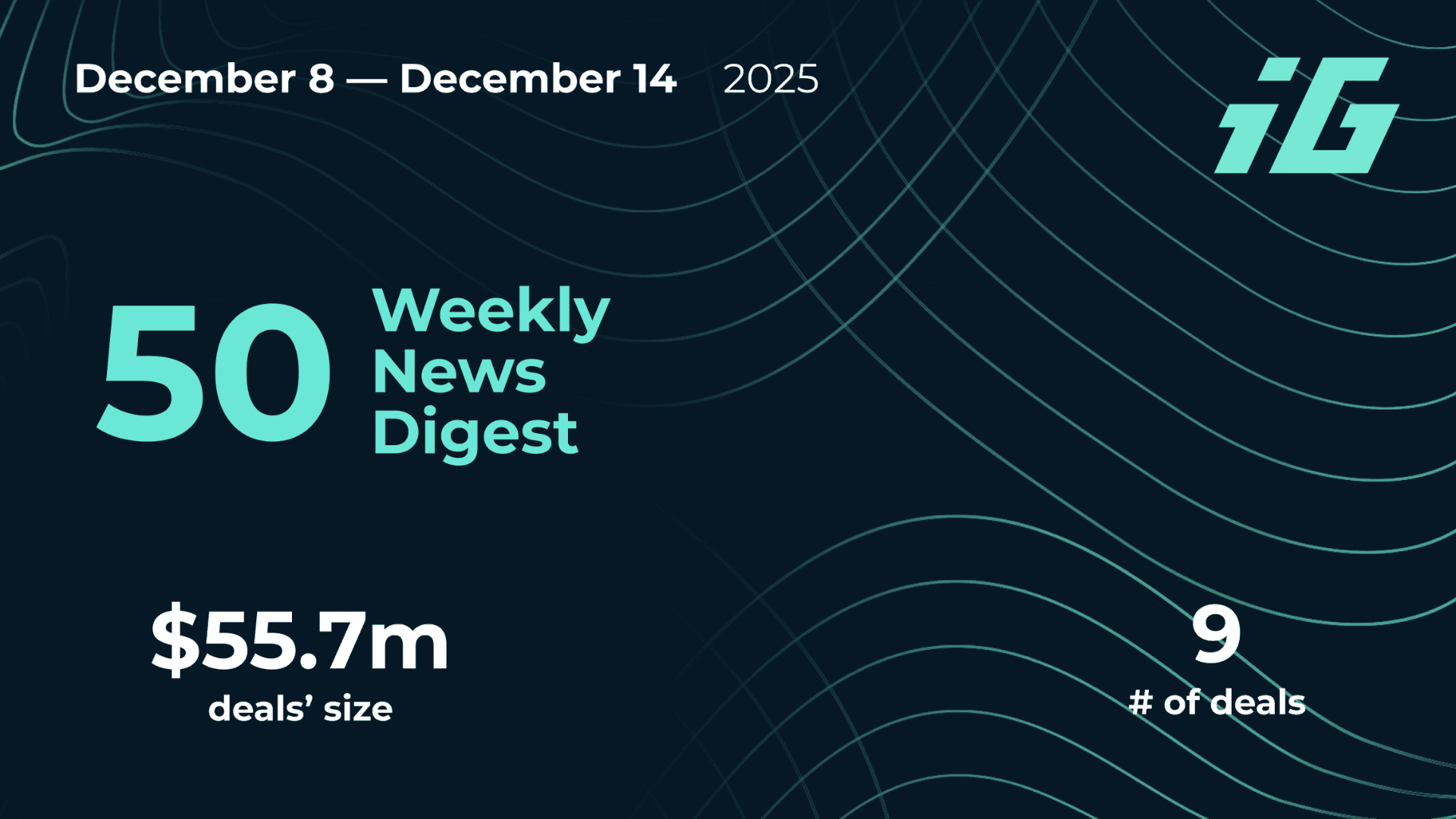

As reported by Invest Game, Investment and dealmaking activity across the games industry remained steady, with studios, technology providers, and investors completing transactions that span mobile, PC, console, and emerging development tools. Recent moves reflect a focus on long-term content pipelines, production technology, and regional expansion, with activity concentrated in Europe, the Middle East, and Asia.
Regional Deals Highlight Strategic Expansion
In Türkiye, software company Link Bilgisayar completed a $2m investment in metaverse developer Abrakadabra Games, securing a 20% ownership stake through a capital injection. The deal positions Link Bilgisayar to expand further into in-game services and digital entertainment, while providing Abrakadabra Games with funding to support ongoing development initiatives. The studio plans to strengthen its data capabilities, including player behavior modeling and cloud-based gaming infrastructure. Abrakadabra Games had previously sold a 5% minority stake to MİA Teknoloji in November 2025 for $500k.
In the UK, Tencent Holdings finalized the sale of PC and console developer Bulkhead Interactive to Super Media Group, a newly formed consortium backed by everplay group and HIRO Capital. As part of the transaction, everplay acquired a 20% minority stake in Super Media Group for $2.7m (£2m), implying a valuation of $13.5m. Bulkhead, known for Battalion 1944, is currently developing a new title, Wardogs, which will be published by Team17, a division of everplay. Bulkhead had previously been acquired by Splash Damage in December 2022 and was separated from its operations in 2025 ahead of Splash Damage’s own divestment from Tencent.
Funding Rounds Support New Games and Core Technology
Several studios and technology companies also secured fresh capital. US-based PC and console developer Fictions raised $16.7m from undisclosed investors, according to SEC filings. Formerly operating as Private Division, the studio is known for LEGO® Party! and is developing two new projects, Armatus and Beast of Reincarnation, both slated for release in 2026. The company was divested from Take-Two Interactive Software to Haveli Investments in November 2024.
In the UK, graphical technology firm Gracia AI raised $1.7m from EWOR to expand its engineering team and advance its AI-powered 4D Gaussian Splatting volumetric video technology. The company is building cloud-based processing and editing tools, along with production-ready plugins for Unity and Unreal Engine. Its technology is designed for use across gaming, XR, VFX, advertising, and other creative industries. Gracia AI previously raised $1.2m in 2024.
Mobile-focused development also saw continued support. UAE-based studio Hypemasters secured $1m in a round led by Impact46, with participation from GEM Capital. The funding will be used to develop new strategy games and support regional growth across MENA, including plans to open offices in Saudi Arabia. Hypemasters’ existing title, World War Armies, has generated $5.2m in lifetime in-app purchase revenue and reached six million downloads since its 2022 release.
Saudi Arabia-based game technology company Qwacks raised $480k in pre-seed funding led by Merak Capital. The company is developing a full-cycle game development technology layer that includes backend services, AI-driven playtesting, and market insights tools aimed at supporting more data-informed production workflows.
In Europe, Poland-based real money gaming company EasyWin raised an undisclosed seed round at a reported $15.5m valuation. The funding will support international expansion of its tournament platform for casual puzzle games that offer real money prizes. The platform currently reports around 35,000 daily active users and, as of October 2025, had reached a $30m annualized GMV run rate across markets including the US, UK, Germany, Canada, and Australia.
New Capital Targets the Next Wave of Game Technology
On the investor side, UK-based venture capital firm HIRO Capital announced the launch of HIRO III, a new European scale-up fund. The fund will target companies working in areas such as spatial AI, cloud infrastructure, robotics, and games and interactive technologies, with individual investments ranging from $5.85m to $58.5m. Initial investments are expected to begin in 2026. The fund will be managed by HIRO Capital’s founding partners and will include Sir Nick Clegg, former President of Global Affairs at Meta and former UK Deputy Prime Minister.
Public Market Moves Signal Ongoing Restructuring
In Japan, mobile game developer KLab announced plans to raise $32.9m (¥5.1B) through a third-party share allocation to a group of strategic and financial investors. The transaction, expected to close on December 23, 2025, includes the issuance of new shares and fixed-price warrants. If all warrants are exercised, United Capital Investments Group would become KLab’s largest shareholder with an estimated 23.2% stake. KLab is best known for anime-based mobile titles including Bleach: Brave Souls, Captain Tsubasa: Dream Team, and Love Live! School Idol Festival.
Source: Invest Game
Frequently Asked Questions (FAQs)
What trends are shaping current gaming investments?
Recent investments show a focus on sustainable content pipelines, production and development technology, and regional expansion. Investors are backing both game studios and the tools that support game creation, including AI-driven and cloud-based solutions.
Why are technology platforms attracting funding alongside game studios?
Game development is increasingly reliant on advanced tools for production, testing, and live operations. Companies providing AI, data analytics, and cloud infrastructure are seen as critical enablers for scalable game development.
What regions are seeing the most gaming investment activity?
Recent transactions highlight strong activity in Europe, the Middle East, and Asia, with growing interest in emerging markets such as MENA and continued deal flow in established markets like the UK and Japan.
How do these deals affect players?
While most of these transactions occur behind the scenes, they can influence the scope, quality, and longevity of future games by providing studios with additional resources and more stable development pipelines.
Is web3 a major factor in these recent investments?
Web3 concepts appear more as adjacent considerations rather than core drivers. Most recent deals focus on traditional gaming models, development technology, and infrastructure rather than token-based or blockchain-first approaches.