
Roblox Studio has increasingly become a testing ground for agentic AI assistants designed to help creators build games faster. While these tools can already write scripts, insert assets, and modify environments, measuring how well they actually perform in real development scenarios has been difficult. OpenGameEval aims to address that problem by introducing a Roblox Studio–native framework for evaluating AI assistants under realistic conditions.
Developed by Tiantian Zhang, Kartik Ayyar, Mengsha Sun, and Lynn Gong, OpenGameEval is positioned as the first evaluation system built directly around Roblox Studio’s workflows. Rather than isolating code snippets or relying on stateless prompts, it runs AI models inside simulated edit and play sessions that closely resemble how creators actually work.
Why Traditional Benchmarks Fall Short for Roblox
Most existing AI benchmarks focus on narrow coding problems with clearly defined inputs and outputs. Roblox development rarely fits that mold. Games are built inside persistent 3D worlds where scripts interact with hierarchies of objects, multiplayer networking, and client-server boundaries. Changes made in one part of an experience often depend on context scattered across multiple scripts and instances.
OpenGameEval was created in response to these limitations. Its goal is to test whether an AI assistant can reason through a live Roblox environment, understand existing logic, and make changes that hold up when the game is actually run. This approach shifts evaluation away from theoretical correctness and toward practical usefulness for creators.
A Closer Look at the OpenGameEval Framework
At its core, OpenGameEval recreates the Roblox Studio development environment in a reproducible way. Each evaluation simulates both edit-time and play-time behavior, ensuring that physics, networking, and multiplayer interactions behave exactly as they would in a real project. This allows evaluators to observe how an AI assistant’s changes affect an experience once it is running, not just whether the code compiles.
The framework also includes input simulation, which makes it possible to trigger player actions such as movement, button presses, and camera changes during tests. This is particularly important for evaluating features that only reveal issues through interaction. All of this functionality is exposed through a unified API, making it easier for research teams to compare different large language models on the same set of tasks.
Testing Real Development Scenarios, Not Just Code Snippets
The OpenGameEval benchmark dataset currently includes 47 hand-crafted test cases. Each one is based on common Roblox development tasks, including game mechanics, environment setup, animation, user interfaces, and sound. These scenarios are built and reviewed by domain experts to ensure they reflect real creator workflows.
Unlike traditional coding challenges, these tests are end-to-end. A successful AI assistant must locate relevant scripts, interpret existing logic, decide where new code belongs, and implement changes that work across both client and server. Scoring is handled through executable unit tests and standard metrics such as pass@k, allowing results to be reproduced and compared across models.
How Context Changes the Difficulty
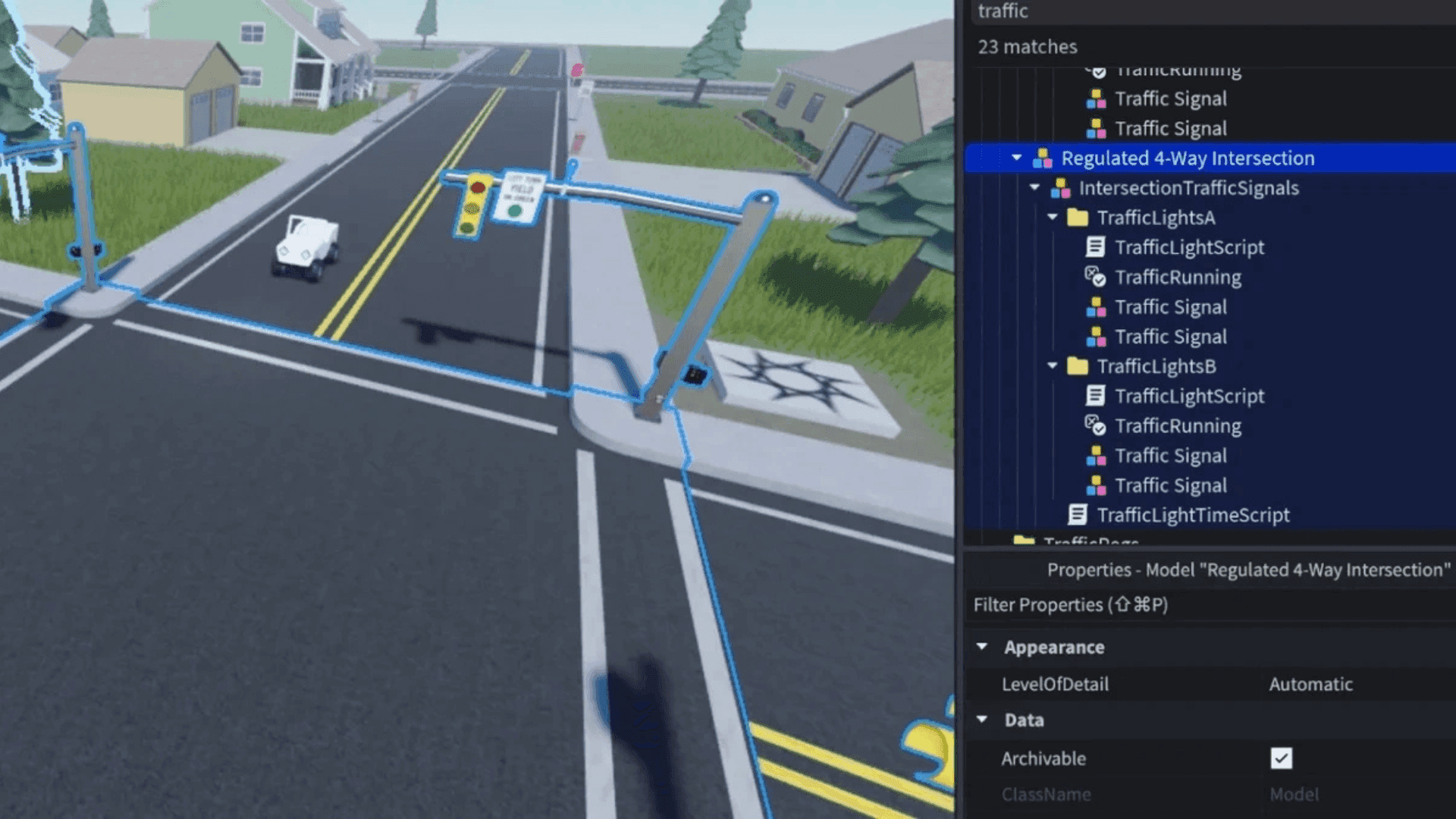
One of OpenGameEval’s defining features is its focus on contextual variation. The same prompt can be evaluated across multiple environments that differ in structure and complexity. For example, a task involving a four-way traffic light might be tested in an empty placefile, a populated suburban scene, or a setup that includes both traffic and pedestrian signals. Each variation forces the AI assistant to adapt its reasoning based on what is already present in the experience.
More complex tasks, such as implementing a health regeneration system, require the model to trace damage logic across scripts, determine whether changes should be made on the server or client, and ensure timing and replication work correctly. These scenarios are designed to reveal whether an AI assistant can maintain context across multiple steps rather than relying on surface-level pattern matching.
Early Results Highlight Current Limitations
Initial results from OpenGameEval suggest a clear divide in current AI capabilities. Models tend to perform well on atomic tasks that involve direct manipulation of a single instance or property. Actions like adjusting a player’s jump power or configuring a particle effect often succeed with high reliability.
Performance drops sharply when tasks require deeper contextual reasoning. Scenarios involving coordinated changes across scripts, careful filtering of relevant objects, or understanding multiplayer behavior continue to produce low success rates. These results underline how much room there is for improvement before AI assistants can reliably handle complex Roblox development tasks on their own.
Signs of Steady Progress
Despite these challenges, OpenGameEval has already captured signs of improvement as models evolve. In one task involving a color change to the Roblox logo, early models failed because the object was not explicitly named. More recent evaluations show some models successfully identifying the correct object by inspecting its properties and position in the instance hierarchy, rather than relying solely on naming conventions.
These incremental gains suggest that AI assistants are slowly improving at structural reasoning within game environments, even if broader contextual understanding remains inconsistent.
What OpenGameEval Means for Creators and Researchers
OpenGameEval is designed to serve both Roblox creators and the wider AI research community. A public leaderboard offers visibility into how different models perform across categories such as code generation and tool use. For researchers, the framework provides a standardized way to run reproducible evaluations inside a real game engine environment.
Looking ahead, the team behind OpenGameEval plans to expand the dataset, refine the evaluation tools, and incorporate feedback from the creator community. The long-term goal is to establish a shared reference point for measuring progress in agentic AI for game development, including future applications tied to web3-style creator economies.
Check out Roblox Gift Cards on Amazon here.
Learn about other popular Roblox experiences here:
Frequently Asked Questions (FAQs)
What is OpenGameEval?
OpenGameEval is an open-source evaluation framework and benchmark designed to test AI assistants directly inside Roblox Studio. It measures how well models perform on real development tasks rather than isolated coding problems.
How is OpenGameEval different from other AI benchmarks?
Unlike traditional benchmarks, OpenGameEval runs evaluations in a simulated Roblox Studio environment. This allows it to test contextual reasoning, multiplayer behavior, and stateful interactions that are common in game development.
What kinds of tasks does OpenGameEval include?
The benchmark includes tasks related to game mechanics, scripting, environment building, animation, user interfaces, and sound. Many tasks require multistep reasoning across multiple scripts and objects.
Who can use OpenGameEval?
The framework is open source and intended for AI researchers, tool developers, and teams building or evaluating AI assistants for Roblox Studio.
Why is OpenGameEval important for Roblox creators?
By providing transparent performance data and realistic evaluations, OpenGameEval helps creators understand the strengths and limitations of AI assistants and track how these tools improve over time.