Open Game Protocol (OGP) is officially live, marking a new step in how web3 games handle player rewards. Created by Zynga co-founder Justin Waldron, the platform is designed to let any cryptocurrency token power a game’s economy. The goal is to connect players, developers, and token communities through a reward system that runs directly from the web, without the need for downloads or complicated blockchain setups.
Open Game Protocol Goes Live
Open Game Protocol Goes Live
At its core, OGP works as a chain-agnostic app layer. It lets developers integrate their games with existing tokens instead of forcing them to launch their own. The platform introduces “gamecoins,” tradable digital assets that control how rewards are distributed.
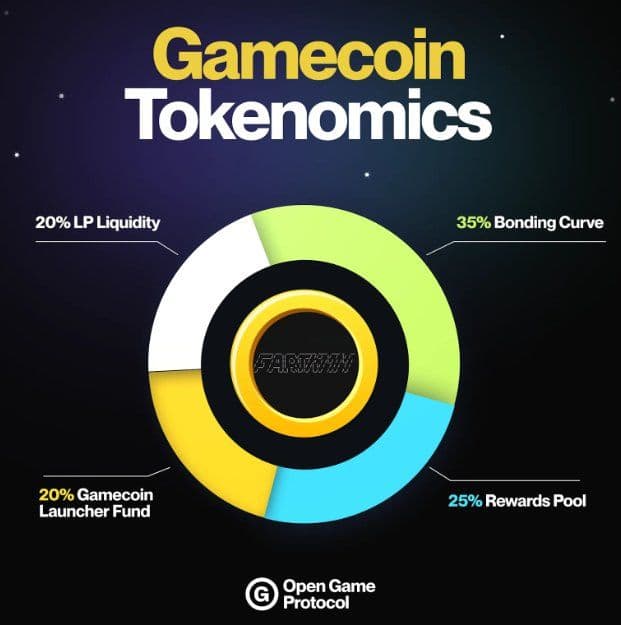
For example, a community could stake a Solana token such as $FARTCOIN to generate a gamecoin called $GFARTCOIN. Once the staking goal is met, stakers receive their original tokens back and gain access to the new gamecoin. That gamecoin can then be linked to multiple games, allowing players to earn rewards in the original token while participating in gameplay tied to that ecosystem.
This system effectively gives any token an in-game use case. Players can earn, developers can monetize, and token holders can see their communities gain activity through gameplay instead of speculation alone.
Open Game Protocol Goes Live
Simplifying Technical Barriers
OGP’s design aims to simplify the technical barriers often found in web3 game development. Developers do not need to write custom smart contracts or hold large token reserves. Instead, communities fund reward pools by staking the tokens they already support, allowing creators to focus on making games rather than managing blockchain mechanics.
According to Waldron, the goal is to make integrating OGP as simple as adding a payment processor. In an interview with Blockworks, he explained that both players and developers benefit from a system that rewards engagement rather than just transactions. “The most important thing for players is that they get rewarded, and that they believe in the rewards they get,” he said. “For developers, it’s about getting players and making a living building games.”
Open Game Protocol Goes Live
Balancing Gameplay with Token Incentives
For years, web3 gaming has struggled to balance gameplay with token incentives. Many projects focus on generating trading activity or total value locked (TVL) rather than improving player experience. OGP’s chain-agnostic approach is meant to solve that misalignment.
By allowing token communities to directly fund game rewards, the system brings developers and investors onto the same page. The more a game grows, the more value the related token community can potentially capture. OGP launched on Solana but plans to expand to other ecosystems, including EVM-compatible chains, in the near future.
Gamecoins to Shape Player Economies
Gamecoins are not traditional in-game currencies. Instead, they function as governance and coordination tools for reward distribution. Waldron explained that a token like $GFARTCOIN determines how much of its parent token, $FARTCOIN, is distributed among the games tied to it. As those games gain popularity, the corresponding gamecoin ecosystem becomes more valuable.
This setup allows players, builders, and token holders to participate in the same reward cycle. The better the games perform, the more everyone stands to gain, making gameplay itself a key part of a token’s overall economy.
Open Game Protocol Goes Live
Games Live on OGP, and Safetly
Several games are already live on OGP. Among them, Network Cities leads with a reward pool valued at over $160,000. Other active titles include Fart Cities, a flappy-style arcade game linked to Fartcoin, and After Egypt (Milady Edition), a browser-based adventure. Smaller titles such as UP ONLY!, Warez Clicker, and Beetle Catcher are also drawing steady engagement.
On the token side, Fartcoin Gamecoin ($GFARTCOIN) currently has the highest market activity, reporting a market cap above $830,000 and daily trading volumes over $1 million. Other gamecoins like ICM.RUN ($GICM), CITIES Gamecoin ($GCITIES), and Tsotchke Gamecoin ($GTSOTCHKE) are also gaining traction.
Team, Partners, and Backnig
The credibility of OGP comes from both its leadership and its investors. Justin Waldron, best known for co-creating some of the most-played social games in the world, is joined by a team of industry veterans. The project is backed by several blockchain-focused venture firms including 1kx, Sora Ventures, Strobe, Foresight Ventures, CMT Digital, Alliance VC, and Merit Circle.
OGP also has a lineup of well-known angel investors across gaming and crypto, including Nao Kitazawa (formerly of Coinbase), Jason Lau (OKX CIO), Rich Rosenblum (GSR co-founder), Matthew Roszak (Bloq co-founder), Scott Moore (Gitcoin co-founder), Evan Cheng (SUI founder), and Calvin Liu (formerly of EigenLayer).
Open Game Protocol Goes Live
Final Thoughts
Waldron and his team are planning a future where web3 gaming integrates even more seamlessly into existing crypto infrastructure. One upcoming feature would allow wallets to display a “Play” button next to supported tokens, giving users instant access to games linked to those assets.
According to Waldron, around 30 to 40 wallet partners have already shown interest in this concept. If implemented, it could redefine how crypto wallets are used - turning them from storage and trading tools into direct gateways for gaming experiences. Open Game Protocol is currently live and accessible through opengameprotocol.com, offering developers and communities a way to turn any token into a playable asset.
Frequently Asked Questions (FAQs)
What is Open Game Protocol (OGP)? Open Game Protocol is a chain-agnostic platform that lets web3 game developers connect their games to existing tokens. It uses “gamecoins” to manage and distribute rewards among players, developers, and token communities.
Who created OGP? OGP was created by Justin Waldron, co-founder of Zynga and one of the developers behind FarmVille and Words With Friends.
How do gamecoins work? Gamecoins are assets tied to specific tokens that control how rewards are distributed across games. They are not used as in-game currencies but as governance tools that influence reward flow and ecosystem growth.
Is there an official OGP token? No. OGP does not have an official token at this time. The platform supports community-launched gamecoins instead.
What blockchains does OGP support? OGP launched on Solana but plans to expand to other networks, including EVM-compatible chains.
How can players access games on OGP? Games on OGP can be played directly through the web using supported wallets like Phantom, MetaMask, or Binance Wallet, without any downloads.
Is Open Game Protocol safe to use? Users are advised to only access OGP through its official website and to avoid unofficial tokens claiming to represent the platform.