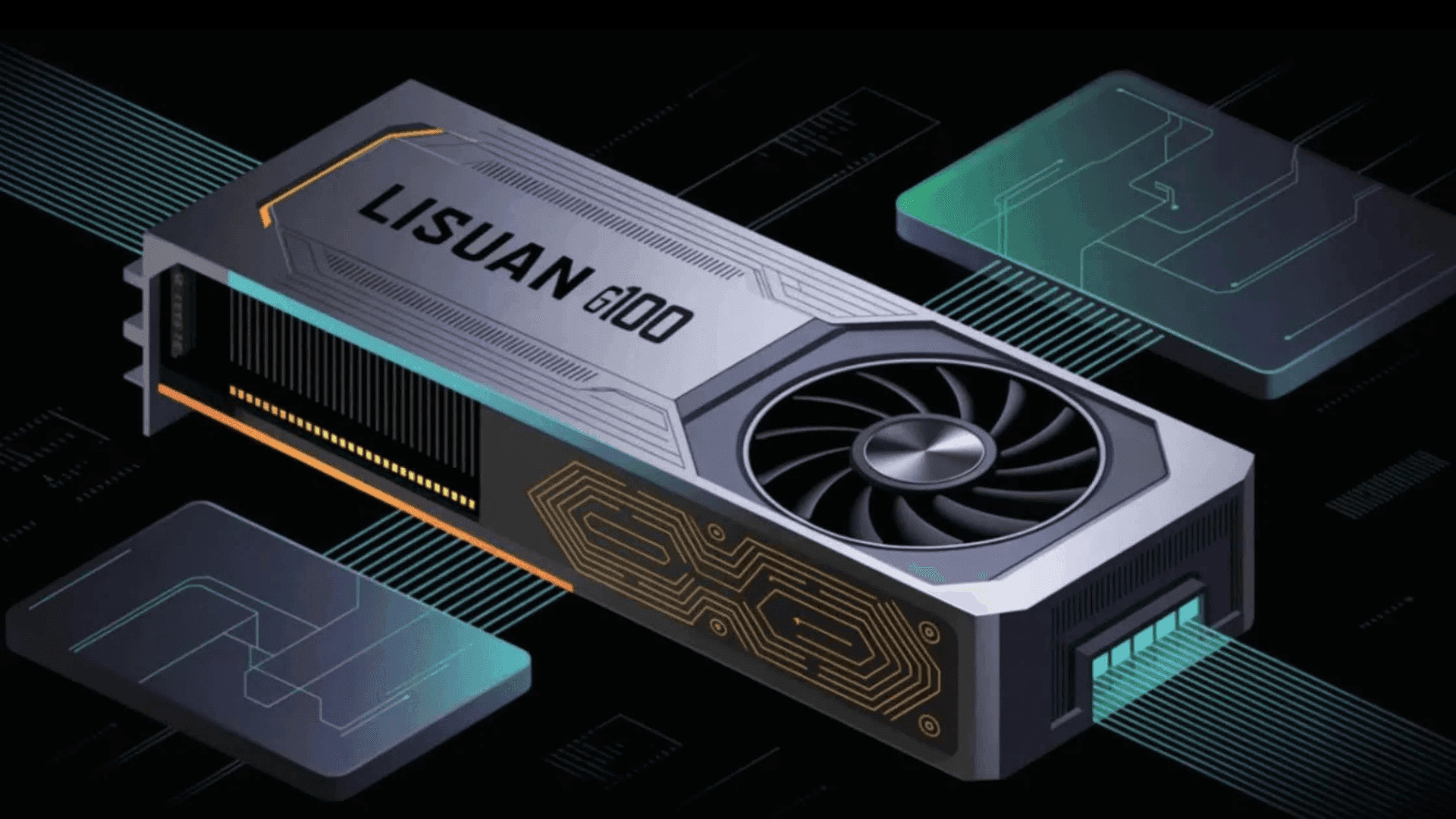

China has entered the consumer GPU space with the launch of the Lisuan G100, marking the country’s first attempt at a gaming-focused graphics card for general users. The release reflects a growing push for domestic alternatives in computing hardware, driven by both national initiatives and a desire to reduce reliance on Western imports. While the card is now shipping, early benchmark results show mixed performance, leaving questions about its competitiveness compared to established players like NVIDIA and AMD.
The Development of Domestic GPUs in China
For decades, China’s graphics processing efforts were largely confined to academic and military projects. Early domestic GPUs, such as Jingjia Micro’s JM series launched in 2006, were designed for aerospace and defense applications and lacked the driver support and DirectX compatibility required for consumer gaming. The real push toward consumer-grade GPUs began around 2018, influenced by trade tensions with the United States and the rise of AI technology. Startups like Biren Technology and Moore Threads emerged during this period, often founded by engineers returning from NVIDIA and AMD. Moore Threads made a significant consumer-facing release in 2022 with the MTT S80, the first domestic gaming card with PCIe 5.0. However, driver instability and inconsistent performance limited its usability in modern games.
Lisuan’s Approach and the G100 Architecture
Lisuan, founded in 2021 by former Silicon Valley engineers, sought to avoid the pitfalls faced by previous domestic GPU projects. The company focused heavily on driver development and software optimization alongside its “TrueGPU” architecture. The Lisuan G100 is built on a 6nm process and is positioned as a competitor to NVIDIA’s RTX 4060 in raw FP32 compute, claiming 24 TFLOPS of performance. It also adds support for Windows on ARM, a feature that even some Western GPUs have not fully prioritized. The G100 is now available to consumers, marking a tangible product rather than a concept or prototype.
Benchmark Performance and Early Reception
Early benchmark tests suggest that the Lisuan G100 does not yet match the performance of modern mid-range GPUs. A leaked Geekbench OpenCL result recorded a score of 15,524, roughly equivalent to a GeForce GTX 660 Ti released in 2012. Reported specifications include 32 compute units, a 300 MHz clock speed, and 256 MB of video memory. These figures indicate that the G100 may struggle with modern games and workloads. Some analysts speculate that these low scores could be due to immature drivers or engineering sample limitations rather than the hardware itself. Regardless, the card currently falls short of the performance levels suggested by Lisuan’s marketing.
The Significance of Lisuan’s First Consumer GPU
Despite its underwhelming early benchmarks, the Lisuan G100 represents a major technical achievement. Building a fully functional GPU architecture from scratch using a domestic 6nm supply chain demonstrates the potential for future growth. The card is capable of booting, running Windows, and supporting modern APIs such as DirectX 12. The Chinese government’s Xinchuang initiative, which aims to replace foreign computers with domestic alternatives, provides Lisuan with a captive market, funding, and real-world user data that will be essential for improving future products.
Outlook for Future Chinese GPUs
It remains uncertain when Lisuan might release a mid-range or flagship GPU that can directly challenge NVIDIA or AMD. Development could take several years, but the company’s early work lays the groundwork for competitive domestic graphics solutions. International availability is also unclear, as Chinese electronics are rarely widely distributed outside of the country. However, the G100’s release signals the start of a broader effort to create a self-sufficient GPU ecosystem in China, with potential implications for the global market and web3 applications that rely on GPU computing.
Make sure to check out our articles on best gaming gadgets:
Best Apple Products for Gaming
Best Nintendo Switch Accessories
Best Gaming Androids (phones)
Frequently Asked Questions (FAQs)
What is the Lisuan G100 GPU?
The Lisuan G100 is China’s first consumer-targeted gaming GPU, designed to run modern APIs like DirectX 12 and support Windows on ARM.
How does the G100 perform compared to NVIDIA or AMD cards?
Early benchmarks show performance roughly equivalent to a GeForce GTX 660 Ti from 2012, which is below modern mid-range GPUs. Driver optimization may improve results over time.
Who developed Lisuan?
Lisuan was founded in 2021 by former Silicon Valley engineers with experience at NVIDIA and AMD.
Why is this GPU significant?
The G100 represents China’s first domestically produced consumer gaming card built on a 6nm process, demonstrating the ability to create functional GPU architecture from scratch.
Will Lisuan release better GPUs in the future?
While the timeline is uncertain, the company’s focus on software and hardware optimization, along with government support, suggests future GPUs could close the gap with Western competitors.
Can international consumers buy the Lisuan G100?
Availability outside China is currently limited and may remain restricted due to the country’s electronics export practices.