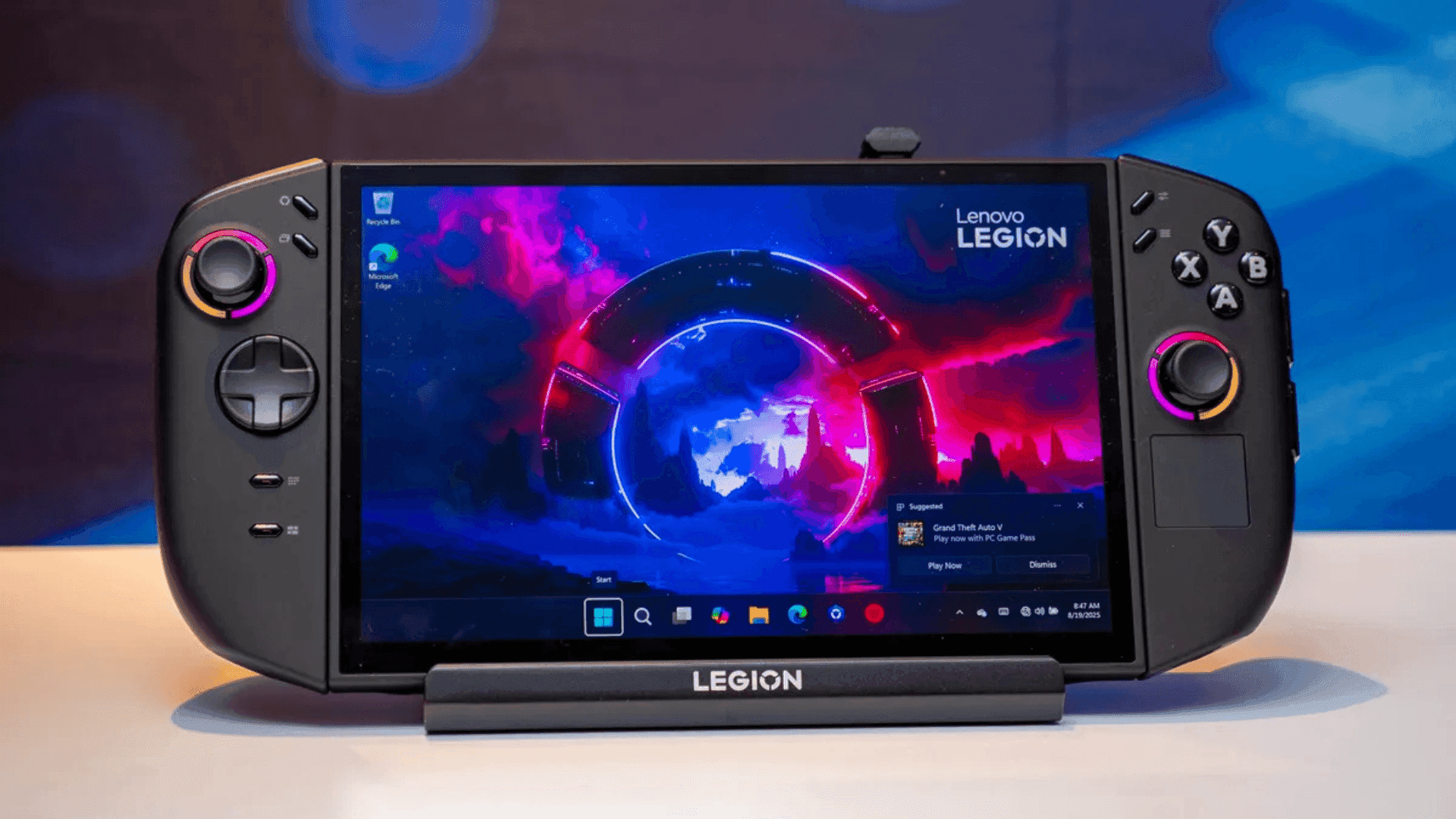

The Lenovo Legion Go 2 has become one of the most discussed gaming devices of 2025, not only because of its performance, but because of how difficult it is to buy at retail price. Units equipped with AMD’s Ryzen Z2 Extreme processor are regularly selling for hundreds of dollars over MSRP on resale platforms, with confirmed purchases showing premiums of roughly $650. While that pricing raises concerns, it also reflects how far handheld gaming PCs have come in a short time.
The Legion Go 2 arrives at a moment when portable PC gaming is no longer experimental. Devices from Lenovo, ASUS, and Valve have pushed the category into the mainstream, and consumer expectations have shifted accordingly. Performance, screen quality, and build are now judged by standards closer to laptops than consoles.
A Clear Focus on Premium Hardware
Lenovo has positioned the Legion Go 2 as a high-end handheld rather than a mass-market option. The most immediate indicator is its 8.8-inch OLED display, which supports up to a 144Hz variable refresh rate and delivers high brightness and full DCI-P3 color coverage. In day-to-day use, the screen is a defining feature, especially compared to smaller LCD panels still common in competing handheld gaming PCs.
Internally, the combination of AMD’s Ryzen Z2 Extreme processor and 32GB of LPDDR5x memory allows the system to handle modern PC games at settings that were unrealistic for handhelds just a few years ago. Storage capacity and expandability also align more closely with traditional gaming laptops, reinforcing Lenovo’s intent to offer a portable PC rather than a console-like experience.
Real-World Performance and Practical Use
In practical gaming scenarios, the Legion Go 2 performs consistently across a wide range of titles. AAA games are playable at stable frame rates when paired with resolution scaling technologies, and less demanding genres run without compromise. Battery life remains a limiting factor, but compared to earlier generations of handheld PCs, efficiency has improved enough that sessions feel less constrained.
The physical size and weight of the device may be a drawback for users seeking maximum portability, but for home use or casual couch gaming, the larger form factor provides ergonomic and visual benefits. Features such as the built-in kickstand and removable controllers add flexibility, particularly for players who alternate between handheld and tabletop-style play.
Windows Gaming and Microsoft’s New Direction
The Legion Go 2 runs Windows 11, a platform that has historically divided handheld PC users. Valve’s SteamOS remains the benchmark for simplicity, but Lenovo has made steady progress with its own software layer. Legion Go Space has improved in responsiveness and usability, reducing friction when navigating games and system settings.
Microsoft’s early-access Xbox Full Screen Experience introduces a more focused gaming mode within Windows, temporarily disabling background processes to improve performance. While the experience is not yet as cohesive as SteamOS, it represents a shift toward acknowledging handheld gaming PCs as a distinct use case. On hardware as capable as the Legion Go 2, Windows 11 is less intrusive than on lower-end devices, though software refinement remains ongoing.
Why the Legion Go 2 Is Selling Above MSRP
Scarcity plays a major role in the Legion Go 2’s inflated resale prices. Retail availability of the Z2 Extreme configuration has been limited, and demand has outpaced supply since launch. At the same time, there are few direct competitors offering the same combination of OLED display size, memory capacity, and processing power.
The willingness of buyers to pay above MSRP also reflects broader trends in PC hardware, where early adopters often absorb higher costs in exchange for access to top-tier components. In this context, the Legion Go 2 has become a reference point for what a premium handheld gaming PC can offer in 2025.
A Market Still Taking Shape
The broader handheld gaming PC market now spans a wide price range, from entry-level devices to premium systems like the Legion Go 2. This diversity gives consumers more choice, but it also highlights ongoing challenges around pricing, battery technology, and software consistency. While web3 concepts are sometimes discussed around future gaming ecosystems, the current appeal of devices like the Legion Go 2 remains rooted in traditional PC gaming performance and accessibility.
As the category continues to evolve, competition from established PC manufacturers and potential new entrants could stabilize pricing and improve availability. For now, the Legion Go 2 stands as one of the clearest examples of how far handheld gaming has progressed.
Make sure to check out our articles on best gaming gadgets in 2025:
Best Apple Products for Gaming
Best Nintendo Switch Accessories
Best Gaming Androids (phones)
Frequently Asked Questions (FAQs)
Why is the Lenovo Legion Go 2 selling above MSRP?
Limited retail availability and high demand for the AMD Ryzen Z2 Extreme configuration have driven resale prices well above MSRP.
Is the Lenovo Legion Go 2 the best handheld gaming PC in 2025?
It is widely considered one of the strongest options due to its OLED display, performance, and build quality, though preferences vary by use case.
Does the Legion Go 2 run Windows 11 well?
On this hardware configuration, Windows 11 performs adequately, especially with Lenovo’s updated software and Microsoft’s Xbox Full Screen Experience.
How does the Legion Go 2 compare to the Steam Deck?
The Legion Go 2 offers more raw performance and a larger OLED display, while the Steam Deck emphasizes ease of use through SteamOS.
Is the Legion Go 2 worth buying at resale prices?
For most buyers, paying significantly above MSRP is difficult to justify, but demand suggests that some users value its features enough to accept the premium.