
Roblox is expanding its ability to support massive, detailed experiences with the introduction of Scalable Lightweight Interactive Models, or SLIM. The system is designed to help creators build richer environments that run smoothly across a broad range of devices. Released on December 5, 2025, SLIM marks a significant upgrade to Roblox’s engine and content streaming systems, aligning with the platform’s ongoing push toward scalable, device-adaptive world building.
A New Approach to Performance Across Devices
Roblox supports millions of daily players on hardware ranging from high-end PCs to low-cost mobile devices. This places substantial pressure on the engine to render large 3D worlds efficiently. SLIM works alongside Roblox’s existing streaming tools to generate lightweight versions of any object in an experience. These versions minimize draw calls, reduce triangle counts, and cut down the number of instances the client must process.
In internal testing, scenes using SLIM showed dramatic decreases in resource usage. Triangle counts dropped from 20 million to 3.35 million, and draw calls fell from 2,402 to 1,454. The reduction helps ensure that players on weaker hardware can explore the same expansive worlds as those on top-tier systems.
How SLIM Builds and Manages Lightweight Models
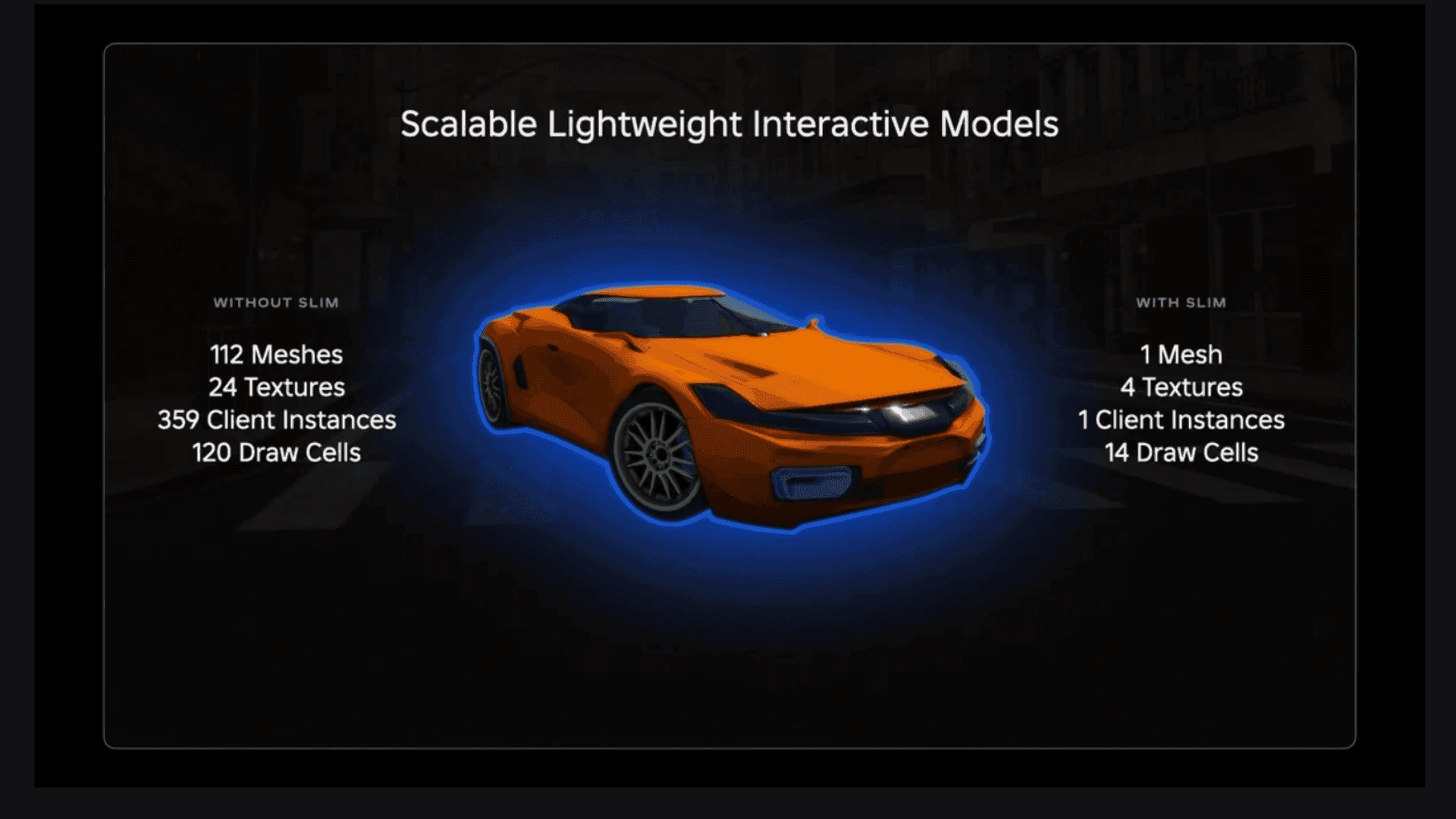
SLIM relies on two main techniques to generate optimized models that can be swapped in and out during gameplay. The first is compositing, which merges many smaller parts into a single structure. A complex vehicle that normally consists of more than a hundred individual meshes can be condensed into one mesh with minimal texturing. This reduces the amount of geometry the engine needs to handle.
The second technique is level of detail generation. After compositing, SLIM produces several simplified versions of the same object, each with fewer triangles and lower-resolution textures. Because SLIM has full context for how creators intended each model to function, it can remove detail intelligently rather than applying a one-size-fits-all reduction.
Rendering That Adapts to Player Position
SLIM doesn’t simply generate lightweight versions; it also determines when to use them. Roblox splits the playable environment into regions based on a player’s proximity to objects. Close-up areas use full high-fidelity models, while middle and far regions rely on SLIM representations. The system continuously adjusts these boundaries to maintain smooth performance.
Harmony, Roblox’s resource-monitoring system, handles the real-time decision-making. It evaluates memory, GPU and CPU load, and network bandwidth every frame. When resources are available, the engine leans into high fidelity. When bandwidth or device power is limited, SLIM steps in to take over rendering at a lower cost.
Building Toward More Scalable Worlds
SLIM is only the first phase of Roblox’s long-term plan to create scalable, high-density worlds that work across diverse device categories. The platform intends to expand SLIM into areas such as avatar optimization, dynamic object support, and more advanced pipeline improvements. Future upgrades may include automated model segmentation, texture re-atlassing, lightweight 2D stand-ins, and hierarchical SLIM systems capable of simplifying entire landscapes.
Roblox also plans to support up-rezzing, allowing SLIM to increase asset quality on next-generation hardware while preserving the original creative intent of each model. The goal is to ensure that as devices advance, older experiences can scale upward rather than remain visually locked to their original assets.
SLIM’s Impact on Roblox’s Future
SLIM gives Roblox a more flexible and efficient foundation for delivering high-fidelity 3D environments. As creators continue building ambitious experiences, the platform’s adaptive rendering and content streaming systems will play a key role in maintaining performance and visual consistency. The introduction of SLIM brings Roblox one step closer to supporting massive, immersive worlds that mirror the scale and complexity of modern games, all while remaining accessible to the platform’s broad global audience.
Check out Roblox Gift Cards on Amazon here.
Learn about other popular Roblox experiences here:
Frequently Asked Questions (FAQs)
What is SLIM on Roblox?
SLIM stands for Scalable Lightweight Interactive Models. It is a system that generates optimized, lightweight versions of 3D objects to improve performance across different devices.
How does SLIM improve Roblox performance?
SLIM reduces triangle counts, draw calls, and the number of instances the engine must handle. This enables smoother rendering and more consistent performance, especially on lower-end devices.
Is SLIM used on all Roblox models?
Currently, SLIM focuses on static creator-designated models. Roblox plans to expand support to avatars and dynamic models in the future.
How does SLIM work with Roblox’s streaming system?
SLIM works alongside instance and asset streaming. Harmony, Roblox’s monitoring system, chooses when to render full models or switch to lightweight SLIM versions based on available resources.
Will SLIM change how creators build experiences?
Creators can continue building normally. SLIM automatically generates optimized versions behind the scenes, allowing large worlds to run more efficiently without manually reworking assets.
Can SLIM increase visual quality on high-end hardware?
Yes. While the current focus is on optimizing downward for performance, future updates will allow SLIM to up-rez assets for next-generation hardware.