
Netflix’s plan to acquire Warner Bros. for $82.7 billion, followed immediately by Paramount Skydance’s $108 billion hostile counter-offer, has become one of the most significant entertainment stories of the year. What stands out just as much as the scale of the deals is what both companies barely acknowledge: gaming.
For an industry that once celebrated Netflix calling Fortnite a rival, the silence marks a noticeable shift. The broader question is whether the games industry should see this as a setback or simply a sign that its future no longer depends on Hollywood’s validation.
Netflix Steps Back from Gaming but Engagement Keeps Rising
Netflix’s early push into games began with enthusiasm. The platform bought several studios, positioned gaming as a strategic priority, and benefited from the growth that followed the pandemic. But the last two years tell a different story.
Team Blue closed in 2024, Boss Fight Entertainment shut down in 2025, and Spry Fox was sold back to its founders. In Netflix’s Warner Bros. acquisition material, games appear only in passing, and leadership has openly described the category as minor.
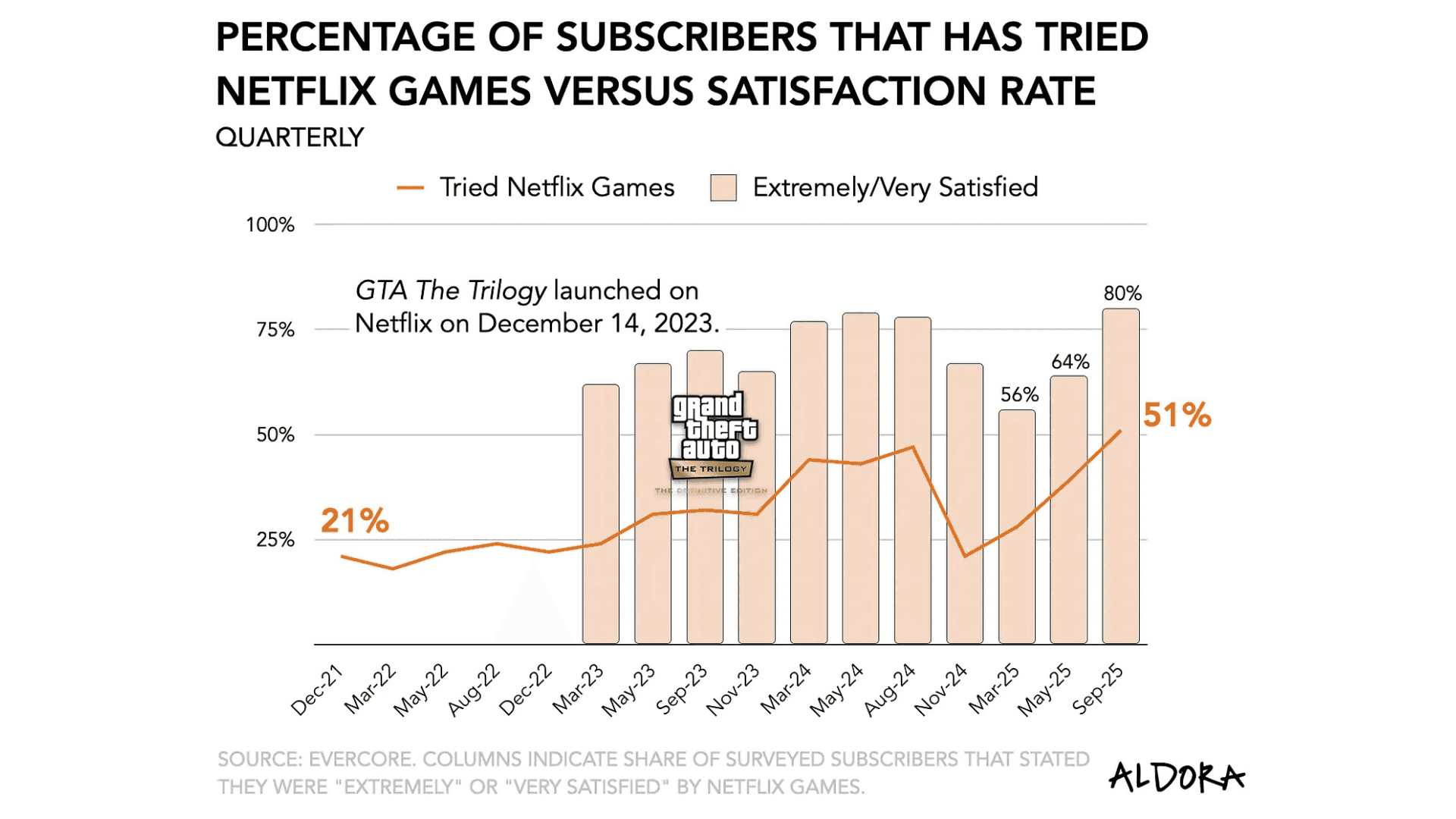
Despite this cooling corporate interest, the user data shows steady progress. More than half of Netflix subscribers have now tried Netflix Games, compared to 39 percent in mid-2025. Satisfaction levels have risen sharply, and major releases continue to drive spikes in engagement.
Grand Theft Auto V’s arrival in late 2023 created the platform’s biggest surge yet before leveling off and returning to a more stable upward trend. Netflix’s ambivalent messaging contrasts with a growing audience that is becoming more comfortable with games delivered through streaming platforms.
Warner Bros. Holds Major IP but Lacks Consistent Direction
Warner Bros. has long held a unique place in gaming. Franchises like Mortal Kombat and Hogwarts Legacy prove the company can produce successful releases, but the division has also faced prolonged uncertainty. Studio leadership turnover and uneven results have raised questions about how gaming fits into the broader organization.
In that context, Netflix’s lack of emphasis on gaming in its acquisition pitch becomes easier to understand. Even with strong IP, Warner Bros.’ gaming division has never operated with the kind of long-term strategy that defines major publishers.
Paramount Skydance Shows Interest but Still Has Something to Prove
Paramount Skydance brings a different angle to the conversation. Unlike Netflix, Skydance highlights gaming as a notable asset. Under Amy Hennig, Skydance New Media is developing projects based on Marvel and Lucasfilm properties, and the company’s acquisition materials directly reference its interactive capabilities.
Its ambition is clear, but its track record is still developing. The Halo TV adaptation underperformed, and its newer gaming-related productions are still in progress. The company is investing in gaming, but it has not yet shown how these efforts will scale or how they will integrate with major entertainment assets like Warner Bros.
Hollywood Still Misunderstands What Makes Games Successful
The biggest disconnect revealed by these acquisition plans is how differently Hollywood and the games industry operate. Traditional media revolves around standalone releases. Studios invest heavily, promote the final product, and wait for audience reactions.
Games work in a continuous cycle built around early access versions, regular updates, community feedback, and live-service features. Developers engage directly with players, and the relationship evolves over years instead of months.
Industry data reinforces how valuable this interactive model is. Titles that support user-generated content earn more revenue over time, retain players longer, and see higher conversion rates for premium add-ons. Roblox’s creator ecosystem continues to grow, demonstrating how communities now function as essential economic contributors rather than passive audiences.
None of this aligns with Hollywood’s established production methods, which makes gaming difficult to integrate into the kind of large-scale media bundles that the acquisitions aim to build.
Why Gaming Doesn’t Need a Place in Hollywood’s Latest Strategy
The absence of gaming from these billion-dollar narratives may seem like a demotion, but for the industry it may simply reflect a natural separation. Games and traditional entertainment no longer share the same production logic, community structure, or revenue patterns.
As streaming giants look for efficiencies and bundled subscription models that resemble the old cable approach, gaming continues to evolve around engagement-driven ecosystems and player participation.
Rather than relying on Hollywood to elevate its status, the games industry has already established its own independent path. The cultural and commercial influence of games continues to grow, and neither Netflix nor Paramount Skydance needs to validate the sector for it to thrive.
In that sense, being left out of these major acquisition strategies may be less a loss and more a recognition that gaming now operates on a separate track with stronger long-term momentum.
Source: Joost
Frequently Asked Questions (FAQs)
Why didn’t Netflix highlight gaming in its Warner Bros. acquisition plan?
Netflix appears to be de-emphasizing gaming at the strategic level, likely because it has not yet built the internal capabilities needed to scale game development, despite growing engagement from subscribers.
Is Netflix giving up on gaming entirely?
Current data suggests no. Subscriber engagement with Netflix Games continues to rise, even as the company trims its studio operations and avoids promoting the division in major investor presentations.
What role does gaming play for Warner Bros.?
Warner Bros. owns strong gaming IP but has struggled with long-term strategic direction and leadership consistency. As a result, its gaming division has not been positioned as a core business during acquisition talks.
Why is Paramount Skydance interested in interactive entertainment?
Skydance has an expanding games division, led by industry veterans and supported by licensed projects. Its acquisition pitch emphasizes gaming more directly, though its results remain early.
Does Hollywood understand the gaming industry’s business model?
Not fully. Traditional entertainment operates on standalone releases, while games rely on ongoing updates, community participation, and iterative development. This mismatch makes integration difficult.
Should the gaming industry care about being ignored in these deals?
Current trends suggest it shouldn’t. Gaming’s growth model, revenue cycles, and community-driven engagement continue to succeed independently from Hollywood’s content-focused approach.