
The 2025 InGameJob and Values Value Games Industry Employment Survey provides an in-depth look at salaries, workplace dynamics, and career trends across Europe. Conducted from March to June 2025, the survey gathered insights from over 1,650 professionals spanning 85 countries, making it one of the most comprehensive snapshots of the industry this year.
Researchers divided Europe into two segments for analysis: EU countries along with the UK and Switzerland, which included 709 respondents, and non-EU European countries, represented by 543 respondents. The survey captured a range of roles from junior specialists to top management, allowing a detailed view of compensation, job satisfaction, and industry trends.
Workforce Composition and Gender Breakdown
Among survey participants, 56% identified as men, 25% as women, and 19% opted not to disclose their gender. Experience levels were varied, with 8% of respondents classified as juniors, 24% as mid-level specialists, 35% as senior staff, and 29% as top management. This distribution shows that the survey captured a broad spectrum of professionals, though experienced employees are more heavily represented.
Salary Landscape Across Europe
Salaries in the European games industry show significant regional differences. In the EU, UK, and Switzerland, senior specialists earn a median gross salary between €43,500 for artists and designers and €92,500 for top managers. Middle-level professionals in the same region see median salaries of around €41,000, with product and project managers among the highest earners.
In non-EU European countries, salaries are considerably lower, often roughly half of what similar roles earn in EU-aligned countries. The disparity is especially pronounced for HR, recruitment, and marketing positions, while QA specialists consistently report the lowest earnings, with a median of €16,935 in non-EU countries. The gap between junior and senior roles is narrower in EU-aligned countries than in non-EU countries, where entry-level positions often pay less than €1,000 per month.
Company Type and Game Genre Impact on Salaries
Companies operating in social networks, streaming, and web-related services report the highest median salaries, influenced by large global technology firms. Publishers and product-focused companies offer competitive compensation, whereas marketing agencies and ad tech firms provide lower salaries. PC developers earn comparatively less, likely due to the prevalence of indie studios within the sample.
Salaries also vary by game genre. Hypercasual and midcore games provide the highest pay, while educational and children’s games rank lowest. Among genres, employees working on fighting games, MMO, MMORPG, tower defense, and hidden-object titles generally earn the most, whereas AR developers receive the lowest compensation.
Trends in Salary Growth and AI Impact
In the EU, UK, and Switzerland, salary growth over the past three years has been strongest for senior marketing professionals and top management. Developer salaries, particularly for programmers working with Unity, have declined due to market competition and fewer open roles. In non-EU European countries, salaries are generally stagnant or decreasing, with mid-level specialists seeing drops across most disciplines. Artists and QA professionals are a notable exception in EU-aligned countries, where their median salaries have increased.
AI adoption is reshaping work in the industry. Over the past two years, AI use in day-to-day tasks has doubled, reaching 63% in EU-aligned countries and 69% in non-EU countries. Analysts, HR staff, recruiters, and top managers are the most frequent users, while artists and QA specialists use AI tools less often. AI integration is influencing productivity and expectations, especially in web3-related projects, and specialists in AI-related roles are currently seeing rising salaries.
Employee Satisfaction and Workplace Dynamics
Overall salary satisfaction declined across the board in 2025. Junior artists and mid-level and senior QA specialists report the lowest levels of contentment with their pay, while junior and mid-level programmers and marketers in EU-aligned countries are generally more satisfied. The gender pay gap remains, particularly at senior levels and in project management, though women earn more in certain marketing, business development, sales, and QA roles. Differences in salary expectations partially explain these disparities.
Paid sick leave and annual bonuses are the most common benefits, though fewer than half of respondents have access to paid leave. Profit-sharing, stock options, royalties, and performance bonuses improve employee loyalty, which overall declined in 2025. Hybrid work models are associated with higher loyalty, while fully office-based roles show lower commitment. Remote work has become the most common format, especially outside the EU, though many employees prefer a hybrid approach.
Career Mobility and Job Search Patterns
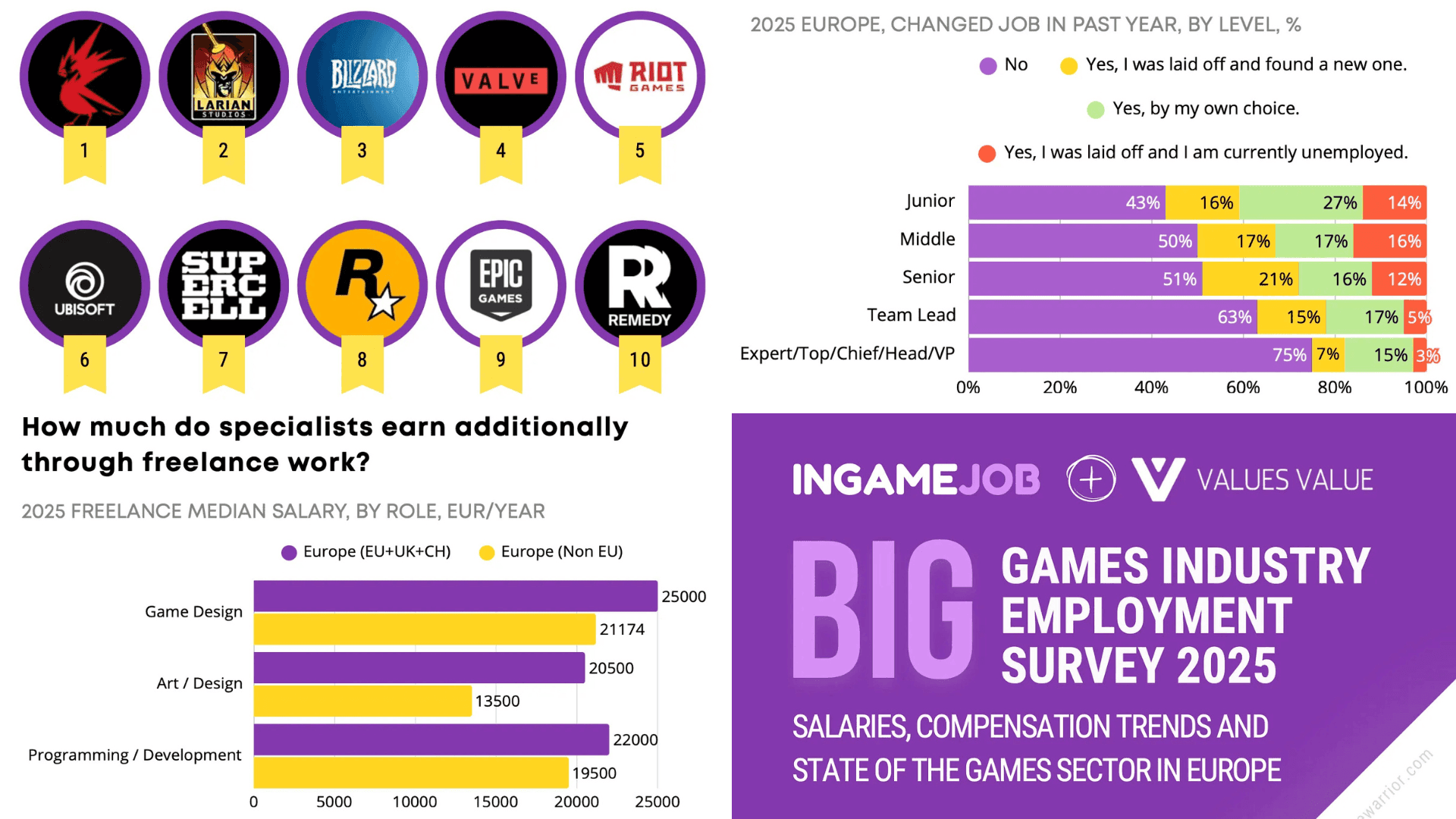
Voluntary job changes fell to 17.5% in 2025, down from 23.2% the previous year. Layoffs affected over 10% of respondents, and job mobility decreases with seniority. HR and recruitment professionals remain the most active in switching roles, while artists, designers, and project or product managers are more frequently affected by layoffs.
Salary remains the main factor in changing employers, with company mission or social impact considered secondary. Job searches can last up to a year, with junior specialists facing the most challenges, and nearly 38% of junior employees leaving the industry after failing to secure better positions.
Freelance Work and Side Projects
Freelance and side projects are widespread, particularly among artists and developers. Median income from side projects ranges from €13,500 for artists in non-EU countries to €25,000 for designers in EU-aligned countries. Senior-level employees are more likely to maintain side projects, while top managers tend to focus on their primary responsibilities due to bonus systems and royalties.
Workload, Well-being, and Professional Development
Overtime is common, with nearly one-third of respondents working extra hours weekly, while 46% report overtime only occasionally. Managers and top management are most affected, followed by mid-level specialists. Professional burnout, ineffective management, and team conflicts are cited as the main workplace issues. Employee development is limited, with 55% reporting no training in the past year and many smaller companies lacking formal growth plans.
Industry Preferences and Career Outlook
Respondents show the highest preference for companies like CD Projekt RED, Larian Studios, and Blizzard Entertainment. Many professionals hope to work on large-scale RPGs, even if their current roles do not align with these preferences. Anxiety about future stability has increased in 2025, particularly among support staff, PR professionals, community managers, and audio specialists, whereas higher-ranking employees report greater confidence in the industry outlook.
Source: GameDevReports
Frequently Asked Questions (FAQs)
What is the average salary in the European games industry?
Salaries vary widely by region and role. In EU-aligned countries, senior specialists earn between €43,500 and €92,500, while non-EU countries report lower median salaries, often around half that range.
Which game genres offer the highest salaries?
Employees working in hypercasual, midcore, fighting games, MMOs, MMORPGs, tower defense, and hidden-object titles generally earn the highest salaries, while educational and children’s games and AR development offer lower pay.
How is AI affecting the games industry?
AI adoption has doubled in recent years, with analysts, HR, recruiters, and top managers using AI most frequently. AI tools are influencing productivity expectations and salary trends, particularly in web3 and development roles.
What are the most common employee benefits?
Paid sick leave and annual bonuses are most common, along with health insurance, sports programs, corporate events, and occasional office perks. Profit-sharing, stock options, and performance bonuses increase loyalty.
Are women paid less than men in the games industry?
Yes, a gender pay gap persists, especially in top management and project management roles. However, women earn more than men in some marketing, sales, business development, and QA positions.
Which companies are most desired by professionals?
CD Projekt RED, Larian Studios, and Blizzard Entertainment are the top preferred employers, with many employees aiming to work on large-scale RPGs.
How has job mobility changed in 2025?
Voluntary job changes decreased to 17.5%, with layoffs affecting over 10% of employees. Junior specialists face the longest job searches, and many leave the industry if unable to find better positions.