

Starting Alchemy Factory feels like opening a cozy potion shop, but within hours you'll be designing conveyor systems that would make a logistics engineer weep. The jump from manually restocking shelves to running a fully automated industrial complex happens fast, and if you don't understand the fundamentals, you'll spend hours untangling belts and going broke.
Here's what you actually need to know to succeed.
How the Game's Economy Works
Money in Alchemy Factory isn't an abstract number. It's a physical item that occupies space, clogs belts, and needs constant management.
Your Cash Register fills up with copper coins after sales. If it overflows, customers can't pay and leave angry. You need to belt those coins out immediately, but here's the problem: copper coins stack to only 50 per belt slot. Once you're making serious money, you'll have thousands of copper coins jamming your logistics.
The solution is Bank Portals. Place one directly under your register and set it to convert copper to silver (50:1 ratio). This compresses your wealth and keeps your belts flowing. Later, you'll convert silver to gold using the same method.

Pro Tip: Place your bank portal as close to the register as possible. Every tile of belt between them is potential overflow space you can't afford.
The Three Income Streams You Need
Your revenue comes from three sources, and you need all of them:
The Shop generates steady income but requires constant restocking. Automate this with Catapults launching products directly onto shelves. Higher shop reputation means richer customers, so keep every shelf type stocked even if you're not selling much of it.
Quest Contracts pay 130% to 200% of market value. Always prioritize these, but be careful unlocking new items in your tech tree. Once unlocked, customers and quests will request them. If you can't deliver, you miss out on premium payments.
Supply Portals let you dump excess production for passive income. The margins are lower than shop sales, but you can move massive volume without waiting for foot traffic.
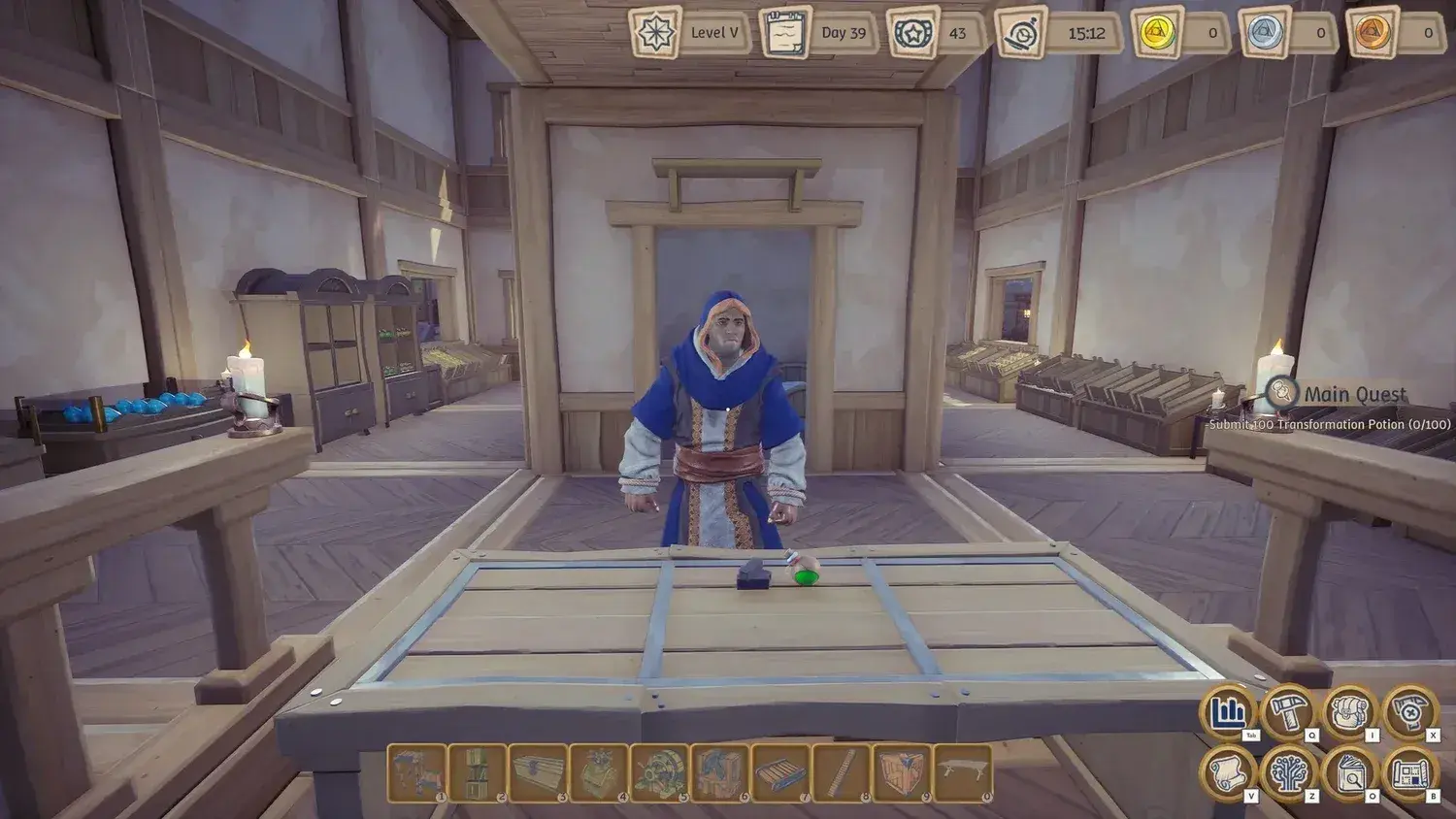
Alchemy Factory Cash register
Transformation Hotkey
Press T while holding any object to cycle through alternate forms. This single mechanic unlocks compact builds that would otherwise be impossible.
Conveyor belts can change direction. Storage containers can rotate vertically or horizontally. Assemblers can mirror to fit tight spaces. The basic wooden chest transforms into a vertical buffer or pass-through container.
Before you demolish half your factory because something won't fit, hit T a few times. You'll usually find the orientation you need.
Important
When placing Conveyor Lifts, align the bottom first, then hold left-click and move your mouse to position the top. Press R while holding to rotate the top exit. This lets you build vertical logistics without wasting space.Production Ratios
Every machine has a production rate measured in items per minute. Ignore these ratios and you'll build bottlenecks that waste resources and space.
Grinders process at 20 items per minute. If your next machine requires 60 per minute, you need exactly three grinders feeding it. Build two and you'll starve the line. Build four and one sits idle.
Table Saws produce 30 planks per minute from logs. Processors making small wooden gears consume 10 per minute. One saw feeds three processors perfectly.
The game won't tell you when ratios are wrong. You'll just notice machines sitting empty or materials piling up. Check production rates in the build menu before placing machines.

Alchemy Factory production ratios
The Flax Problem
Linen Rope requires flax, but so do Healing Potions. You need massive amounts of flax to progress, but crop plots are expensive and slow.
Plant at least 8-10 flax plots early. Use three Grinders to process flax into Flax Fiber at 20 per minute each (60 total). Feed that into one Processor making Linen Thread (requires 60 per minute), then into another Processor making rope.
For potions, you need separate grinder lines for flax and sage. Three grinders each feeding into Assemblers producing potions at 5 per minute. Two assemblers give you 10 healing potions per minute, which is exactly what you need to unlock Level 4.
Fuel Economics Nobody Explains
Heat powers your furnaces, and not all fuel is equal. Early game, burn Boards (planks). They provide roughly 20 heat per coin spent and are easy to mass-produce.
Don't bother making Charcoal yet. The heat efficiency gain is marginal when you factor in the fuel cost of making charcoal itself. Save your coal for the Blast Furnace at higher levels, where the high heat density actually matters.
Warning
Furnaces consume fuel continuously once loaded, even when idle. Don't fuel a furnace until you're ready to use it, or you'll burn through resources while producing nothing.

Efficient fuel management
How to Automate
Supply Portals are your gateway to true automation. Place them behind machines and they'll automatically feed resources as needed.
You need coins to power them. Here's the efficient setup:
- Belt coins from your register to a central storage area
- Use a Bank Portal to convert copper to silver
- Belt silver to each supply portal location
- Set each portal to provide the specific resource that machine needs
Stone goes to crushers. Wood logs go to saws. Iron ore goes to smelters. Once this system runs, you never manually restock raw materials again.
The trick is placing portals close to machines. Every belt tile between portal and machine is wasted space. Build tight, stack vertically using Lab Stands and platforms.
When To Unlock The Cash Register
The Automatic Cashier unlocks at Level 4 and changes everything. Before this, you're stuck manually checking out customers while trying to build. After, the register handles sales automatically and belts coins to your storage system.
Rush to Level 4 by completing the 100 Healing Potions quest. This requires:
- 3 Flax crop plots minimum (preferably 6-8)
- 3 Sage crop plots
- 6 Grinders total (3 for flax, 3 for sage)
- 2 Assemblers making potions
- Proper belting to connect everything
Once you have the register, place it at your shop entrance and route coins immediately to your bank portal. Now you can focus on production while money flows automatically.
Building Vertical Before You Run Out Of Space
Land plots are expensive. Going vertical is cheaper and keeps production chains compact.
Use Platforms and Stairs (unlocked via the Building Tool upgrade) to create second and third floors. Place production upstairs, route finished goods down via Conveyor Lifts, and keep your shop floor clean for customers.
The most efficient factories stack machines directly above each other, using vertical conveyors to move materials between floors. This minimizes belt length and keeps everything accessible.
Tip
Press B to enter Blueprint mode once you've perfected a production setup. Save it, then paste copies whenever you need that production line again. This saves hours of rebuilding the same configurations.The First 100 Days Roadmap
Here's your progression path:
Days 1-3: Build basic production (planks, gears, rope). Manually stock shelves. Save money for crop plots.
Days 4-7: Plant flax and sage. Build grinder lines for healing potions. Rush Level 4 for the cash register.
Days 8-15: Automate shop restocking with catapults. Set up supply portals for raw materials. Build vertical to save space.
Days 16-30: Unlock iron production. Start relic production (sell most, study some). Expand shop with new product lines.
Days 31-100: Optimize production ratios. Build dedicated money conversion systems. Expand to new land plots only when vertical building is maxed.
The players who succeed are the ones who automate early and reinvest profits into production capacity, not land. Build up before you build out.
Your Factory Awaits
There you go, folks, your guide to going from a basic shop setup to running a full-on automated factory, churning out relics without breaking a sweat. Get those ratios right, build up vertically from the start, automate early around day 10, and you'll see the money roll in while others deal with jammed belts. Alchemy Factory starts off all cozy but turns into this wild Factorio-style puzzle real quick. Once those portals start working, it's hard to stop.Thanks for reading—you guys make sha